
Types of Cryptocurrency: Coins vs Tokens
Most people use “coin” and “token” interchangeably. Even experienced crypto holders do it. But they mean different things — structurally different things — and that difference has real consequences for how these assets work, what risks they carry, and why they exist in the first place.
This isn’t just semantic housekeeping. Understanding the distinction between coins and tokens is one of those foundational things that makes everything else in crypto make more sense. Why does Ethereum have “gas fees” paid in ETH? Why can a token exist on a blockchain it didn’t create? Why do some projects launch their own blockchain while others don’t bother? All of that starts here.
The Core Distinction: Native vs. Built On Top
Here’s the cleanest way to think about it.
A coin is the native currency of its own blockchain. It exists because that blockchain exists. Bitcoin (BTC) runs on the Bitcoin blockchain. Ether (ETH) runs on the Ethereum blockchain. Solana (SOL) runs on the Solana blockchain. The coin and the chain are inseparable — one created the other.
A token is built on top of an existing blockchain. It doesn’t have its own chain. It uses someone else’s infrastructure. USDC (a stablecoin) runs on Ethereum, but it’s not Ethereum’s native currency. Chainlink (LINK) runs on Ethereum, but it’s not ETH. Shiba Inu ran on Ethereum before branching out. None of them created their own blockchain. They borrowed one.
That’s the whole distinction in its simplest form. Everything else is detail built on top of that foundation.
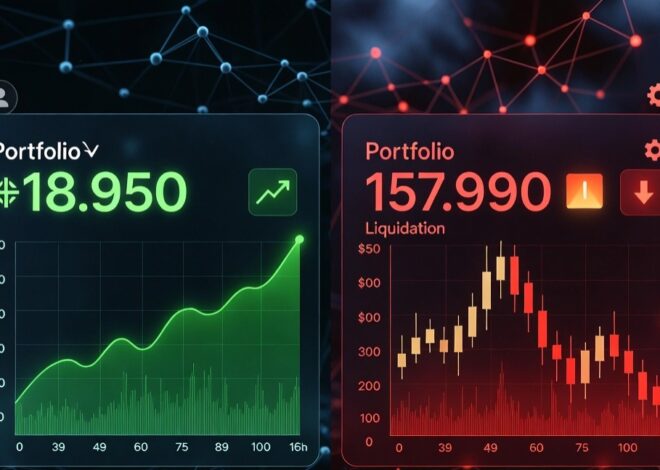
Cascading margin calls amplify downside moves. Prevent forced selling with crash liquidity strategies.
Coins: What They Are and Why They Exist
Coins serve a specific purpose within their native blockchain. They’re not just a medium of exchange — they’re the mechanism that keeps the entire network running.
On the Bitcoin blockchain, BTC is the reward miners receive for validating transactions and adding new blocks. Take BTC away and there’s no incentive to run the network. The coin is the fuel and the incentive system simultaneously.
On Ethereum, ETH does something similar but more complex. Every action on the Ethereum blockchain — sending a token, interacting with a smart contract, using a decentralized app — costs a fee paid in ETH. This fee is called gas. Gas isn’t a transaction fee in the traditional sense; it’s computational pricing. More complex operations cost more gas. ETH is what the network runs on, and no other token can substitute for it in this role. You can hold a thousand different tokens on Ethereum, but you still need ETH in your wallet to move any of them.
This is a point worth sitting with. A lot of people buy tokens on Ethereum and then discover they can’t do anything with them because they don’t have enough ETH to pay gas. The tokens exist on the Ethereum network. The network charges ETH. No ETH, no movement. Coins are the base layer.
The major coins by category:
Proof of Work coins — secured by mining, computational power. Bitcoin is the dominant example. Litecoin, Bitcoin Cash, and Monero also use this model.
Proof of Stake coins — secured by validators who lock up (“stake”) their coins as collateral. Ethereum moved to this model in 2022 (the Merge). Solana, Cardano, Avalanche, and Polkadot all use variations of this. Validators earn rewards for honest participation and risk losing staked coins if they behave dishonestly — this risk is called slashing.
Layer 1 coins — the native currency of a base-layer blockchain. ETH, SOL, AVAX, ADA. These blockchains handle their own consensus, their own security, their own transaction finality.
Layer 2 coins — some Layer 2 networks (built on top of Layer 1s to improve speed and reduce fees) have their own tokens. Polygon (MATIC, now POL) is the most prominent example — built to scale Ethereum transactions, with its own token used for network fees on that layer.
DXY inverse correlation and safe haven dynamics. Related to interest rate hike impacts on relative returns.
Tokens: The Broader, Messier, More Varied Category
Tokens are where the crypto world gets genuinely creative — and genuinely complicated.
Because building a token doesn’t require building a blockchain, the barrier to entry is low. You can deploy a token on Ethereum in an afternoon using standard smart contract templates. This means the token category encompasses everything from billion-dollar DeFi protocols to anonymous meme coins created as jokes, to fraudulent projects designed specifically to steal money. The same infrastructure serves all of them.
Understanding token types helps here because the differences are meaningful.
Fear & Greed index and social volume metrics. Behavioral context for why crypto is crashing analysis.
Utility Tokens: Access Rights Built Into Code
A utility token gives its holder the right to use a specific service or platform. It’s not equity. It’s not a share in anything. It’s more like a pre-purchased access pass — except that pass is programmable and tradeable.
Chainlink (LINK) is one of the clearest examples. Chainlink is a network of oracles — services that bring real-world data (price feeds, weather data, sports scores, etc.) onto the blockchain. Smart contracts often need external data to function. Chainlink provides it. LINK is what node operators are paid for providing this data, and what users pay to access the service. The token is not speculative in its design — it has a defined function within a defined system.
Filecoin (FIL) works similarly for decentralized storage. People who contribute storage capacity to the Filecoin network earn FIL. People who want to store files on the network pay FIL. The token is the economic mechanism that makes the marketplace work.
The risk with utility tokens is that their value is closely tied to actual usage of the underlying platform. If the platform doesn’t get adopted, the token has nothing to anchor its value. Many utility tokens from the 2017 ICO era exist today as near-worthless assets because the platforms they were supposed to power were never meaningfully used.
20% drawdowns versus 50%+ structural breaks—recovery timelines differ massively. Apply during today’s crypto tanking assessment.
Governance Tokens: Voting Rights on a Blockchain
Governance tokens give holders the ability to vote on decisions about a protocol’s development — fee structures, treasury spending, protocol upgrades, new features.
Uniswap (UNI) is the most prominent example. Uniswap is the largest decentralized exchange by trading volume. UNI holders can propose and vote on changes to how the protocol works. In theory, this makes the protocol truly decentralized — decisions are made by the community of holders rather than a company.
In practice, governance participation tends to be low, and large holders (often the founding team and early venture investors who received large token allocations) have disproportionate voting power. The decentralization story is real but complicated.
Compound (COMP) in DeFi lending, Aave (AAVE) for borrowing and lending, MakerDAO (MKR) for the DAI stablecoin system — these all use governance tokens to manage their protocols.
The interesting risk here is that governance token value can disconnect from the protocol’s actual financial performance. A protocol can process billions in trading volume while the governance token trades sideways, because holding the token doesn’t automatically entitle you to a share of protocol revenue — unless a governance vote specifically enables that.
Flight to quality versus liquidity crunch responses. Historical parallels in Bitcoin history from 2009.
Security Tokens: The Bridge Between Crypto and Traditional Finance
Security tokens are the most regulated category. They represent ownership in a real-world asset — a company’s equity, a piece of real estate, a bond — tokenized and issued on a blockchain.
In the US, security tokens must comply with SEC regulations. They can’t be sold to the general public without going through processes similar to traditional securities offerings. This makes them less common in retail crypto markets, but they’re increasingly relevant in institutional and private markets.
The appeal is clear: programmable ownership records, faster settlement, fractional ownership of assets that were previously illiquid (you can own 0.001% of a commercial building), and 24/7 trading without a traditional exchange infrastructure.
The complication is regulatory. Many tokens that should be classified as securities — because they represent an investment in a common enterprise with an expectation of profit — have been issued and traded as if they’re utility tokens, largely to avoid securities law. This is the core of most SEC enforcement actions against crypto projects. The Ripple (XRP) case, which dragged through courts for years, was fundamentally about whether XRP is a security or not.
The line is genuinely blurry in some cases and deliberately obscured in others. This regulatory gray area is one of the structural tensions in the entire token ecosystem.
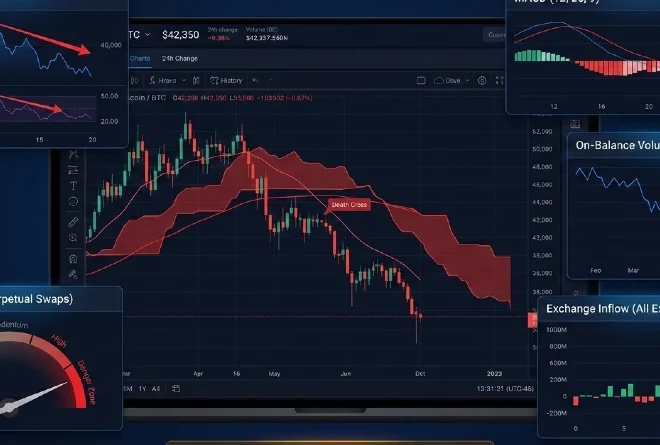
Death crosses, RSI divergences, and volume profile analysis. Confirm with correction versus crash fundamentals.
Stablecoins: Tokens Designed to Not Move
Stablecoins are tokens engineered to maintain a fixed value — almost always pegged to the US dollar at 1:1.
They solve a practical problem: crypto-to-crypto trading without converting back to fiat. If you want to exit a volatile position on a decentralized exchange, you don’t need to convert back to dollars and wait three days for a bank transfer. You swap into USDC or USDT and hold dollar-equivalent value within the crypto ecosystem.
The three main types work very differently:
Fiat-backed stablecoins — USDC (Circle) and USDT (Tether) hold actual dollars (or dollar-equivalent assets like Treasury bills) in reserve. For every USDC in circulation, Circle claims to hold $1 in reserve. This is the simplest model but reintroduces centralization — you’re trusting the company and its auditors to actually hold the reserves.
Tether (USDT) is the most used stablecoin in the world and also the most controversial. For years, Tether’s reserve composition was opaque. It has since published breakdowns showing a mix of cash, Treasury bills, and other assets. The risk remains: if Tether’s reserves prove insufficient during a mass redemption event, the peg could break.
Crypto-collateralized stablecoins — DAI (from MakerDAO) is backed by other cryptocurrencies (primarily ETH) held in smart contracts. Because crypto collateral is volatile, DAI is over-collateralized — you need to lock up more value in ETH than the DAI you receive, creating a buffer. This is more decentralized but more capital-inefficient.
Algorithmic stablecoins — UST (Terra), which collapsed in May 2022, was the most prominent example. Rather than holding reserves, it maintained its peg through algorithmic mechanisms and incentives involving a companion token (LUNA). When confidence broke, the mechanism failed catastrophically. Over $40 billion in value was wiped out in days.
The algorithmic stablecoin model has not recovered reputationally since Terra. The lesson from that event is that a stablecoin’s peg is only as strong as the mechanism and confidence that supports it — and mechanisms can fail in ways that accelerate rather than arrest a collapse.
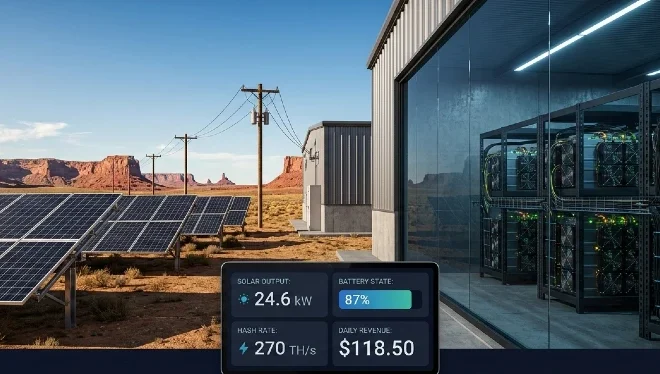
Renewable energy arbitrage for hash rate sustainability. Address ethical implications of energy consumption.
Meme Coins: The Category That Defies Rational Analysis
Dogecoin (DOGE) started as a joke in 2013 — a meme coin featuring a Shiba Inu dog, created in two hours by two developers who wanted to satirize crypto speculation. It has a market cap that has exceeded $80 billion.
Shiba Inu (SHIB) was created as a “Dogecoin killer,” also as something of a joke. It too reached tens of billions in market cap.
Pepe, Floki, Bonk, WIF — the list goes on. Meme coins are tokens with no defined utility, no underlying service, no governance function. Their value is entirely social and speculative. They exist because enough people buy them, talk about them, and hold them that a market forms.
The honest thing to say about meme coins is that they’ve produced some of the largest returns in crypto history — and some of the most catastrophic losses. The people who bought DOGE in 2020 and sold in May 2021 turned small amounts into fortunes. The people who bought at the peak of that run still haven’t recovered.
What meme coins have revealed about crypto markets is actually interesting from a behavioral economics perspective: in a market with low barriers to entry, high social connectivity, and a culture that embraces speculation, pure attention can create value — temporarily. The token has no fundamentals to fall back on when attention moves elsewhere. Which it always does.
Chainalysis, law enforcement coordination, and prevention. Secure future holdings with best Solana wallet practices.
DeFi Tokens: The Most Technically Complex Category
DeFi stands for Decentralized Finance — financial services (lending, borrowing, trading, earning yield) built on blockchains using smart contracts, without banks or intermediaries.
DeFi tokens are typically both governance tokens and utility tokens simultaneously. They govern the protocol and are used within it.
The DeFi ecosystem worth understanding in basic terms:
Automated Market Makers (AMMs) — platforms like Uniswap and Curve that allow token trading without an order book. Prices are set algorithmically based on the ratio of tokens in a liquidity pool. Users who provide liquidity to these pools earn a portion of trading fees.
Lending protocols — Aave and Compound allow people to deposit crypto assets and earn interest, or borrow against their holdings. Interest rates adjust algorithmically based on supply and demand for each asset.
Yield farming — the practice of moving assets between DeFi protocols to maximize returns. It can be lucrative and is also complex, expensive (gas fees), and carries significant smart contract risk — the risk that a bug in the protocol’s code allows someone to drain it.
DeFi tokens carry a distinct risk profile from coins. Smart contract bugs have led to hundreds of millions in losses from protocol exploits. The code is open source, which theoretically allows anyone to audit it, but sophisticated attackers find vulnerabilities that auditors miss. The Ronin Network hack ($625 million), the Wormhole bridge hack ($320 million), and dozens of smaller exploits demonstrate that this risk is not theoretical.
NFTs: Tokens That Are Deliberately Unique
NFTs (Non-Fungible Tokens) are tokens where each one is distinct. Regular tokens are fungible — one ETH is identical to any other ETH. One NFT is not identical to any other NFT within a collection; each has a unique identifier and metadata.
NFTs became culturally prominent in 2021 when digital art, collectibles, and profile pictures sold for extraordinary sums. A single CryptoPunk sold for $23 million. Bored Ape Yacht Club (BAYC) NFTs reached floor prices of $400,000.
By 2022–2023, the market had collapsed. The majority of NFTs from that era trade for a fraction of their peak prices or have no buyers at all.
The underlying technology — provable digital ownership and scarcity on a blockchain — has legitimate use cases beyond speculative art. Event tickets as NFTs prevent counterfeiting and enable traceable resale. Gaming assets as NFTs allow genuine ownership rather than in-game licenses. Digital credentials and certificates as NFTs create verifiable, non-forgeable records.
Whether these use cases develop into large markets, or whether NFTs remain a footnote of the 2021 speculation era, is still being determined.
Wrapped Tokens: The Bridge Between Blockchains
One underexplained category is wrapped tokens.
Wrapped Bitcoin (WBTC) is an ERC-20 token on Ethereum that represents Bitcoin. For every WBTC in existence, one actual BTC is held in custody. The purpose: Bitcoin can’t natively be used in Ethereum’s DeFi ecosystem. WBTC lets Bitcoin holders participate in Ethereum DeFi without selling their BTC.
The wrapping mechanism introduces custodial risk — someone holds the underlying BTC and issues the wrapped version. If that custodian fails or is compromised, the wrapped token becomes worthless while the underlying asset (ideally) remains recoverable.
Wrapped tokens illustrate a broader tension in crypto: the most useful functionality (interoperability between chains) often reintroduces the trust assumptions that blockchain was designed to eliminate. Bridges — the protocols that facilitate wrapped tokens and cross-chain transfers — have been the most exploited infrastructure in crypto, responsible for billions in losses.
The Token Standard That Made All of This Possible
Most tokens on Ethereum follow a technical standard called ERC-20. This standard defines a common set of rules that all tokens on Ethereum must follow — how they’re transferred, how balances are tracked, how they interact with smart contracts.
Before ERC-20, every token had its own custom interface. After ERC-20, any wallet, exchange, or application that supports the standard automatically supports any token built on it. This interoperability is why the Ethereum ecosystem exploded. One standard, infinite tokens.
ERC-721 is the standard for NFTs on Ethereum — the same logic applied to unique, non-fungible assets.
Other blockchains have equivalent standards: SPL tokens on Solana, BEP-20 on BNB Chain. The principle is the same — standardized rules that enable composability across the ecosystem.
Why This Distinction Matters Practically
Understanding coins vs. tokens isn’t academic. It changes how you think about what you’re holding.
A coin’s value has a relatively direct relationship to its network’s usage and security. More activity on the Ethereum network means more demand for ETH to pay gas. The connection is logical and visible.
A token’s value depends on the specific project’s design, adoption, and economics. Some tokens capture value beautifully — they’re required to use a service that many people want. Others are governance tokens for protocols that generate no revenue to distribute. Others are meme coins with nothing anchoring them at all.
When you hold a token, the first question worth asking is: what does this token actually do within its system, and does the system need to work for the token to have value? If the answer to the second part is no — if the token is decorative or speculative without a functional role — then its value rests entirely on continued demand from future buyers. That’s a different, thinner foundation than a token that’s genuinely consumed or required by a working product.
The crypto space is full of both. Knowing which you’re looking at doesn’t guarantee a good outcome, but it clarifies what you’re actually betting on.
And clarity, in a space this noisy, is worth more than most people give it credit for.

Financial Analyst Iqra Zahoor provides data-driven crypto analysis & strategies. Guiding you from market trends to informed investment decisions.