
Bitcoin Crash: What Smart Investors Must Know Now
Every few years, Bitcoin does something that shocks the people who just arrived and barely surprises the people who’ve been here a while.
It crashes. Hard. Fast. And without much warning.
Then the headlines come. “Bitcoin is dead.” “The bubble has burst.” “Crypto is finished.” These aren’t new headlines. They’ve been written in 2011, 2013, 2015, 2018, 2020, and 2022. Bitcoin survived every single one of them and went on to set new all-time highs afterward.
But surviving a crash and navigating a crash are two different things. A lot of people survive Bitcoin crashes the way you survive a car accident — technically intact, but shaken, bruised, and wishing they’d paid more attention to the road before it happened.
This article is about understanding what actually causes these crashes, what separates the people who come out stronger from the ones who come out worse, and what the current moment actually looks like when you strip away the noise.
Bitcoin Has Crashed Before — Here’s the Actual History
Before anything else, context matters. Because “crash” is a word that gets used loosely, and the scale of Bitcoin’s historical drawdowns is something most people genuinely don’t know until they’re inside one.
In 2011, Bitcoin dropped from $32 to $2. That’s a 94% decline.
In 2013–2015, it fell from $1,100 to $170. Another 85% wipeout, spread over about 14 months.
In 2017–2018, the crash that introduced Bitcoin to mainstream media — from $20,000 to $3,200. Over 80% gone.
In 2021–2022, from a peak of $69,000 down to $15,600. Almost 78% erased, with the FTX collapse landing like a final blow near the bottom.
Each one of these felt permanent while it was happening. Each one looked, from the inside, like the end. And after each one, Bitcoin recovered and set new highs.
This pattern doesn’t guarantee the next crash will end the same way. But it’s important context for what “a Bitcoin crash” actually looks like versus how it gets reported.
What Actually Causes a Bitcoin Crash
This is where most coverage goes shallow. “Market sentiment turned negative” or “regulatory fears spooked investors” — true, but incomplete. The real anatomy of a Bitcoin crash is more layered.
Leverage unwinds. This is the dominant mechanical cause of sharp, sudden Bitcoin crashes. A large portion of Bitcoin trading happens in derivatives markets — futures and perpetual contracts where traders can control large positions with relatively small amounts of capital. When prices start dropping, leveraged long positions get liquidated automatically. Each liquidation adds selling pressure. That pressure triggers more liquidations. Within hours, what started as a modest decline becomes a 20–30% vertical drop. This isn’t panic selling alone — it’s a mechanical cascade that the structure of derivative markets produces predictably.
The 2021 May crash, where Bitcoin dropped from $58,000 to $30,000 in a matter of days, was largely a leverage unwind. Over $8 billion in long positions were liquidated in 24 hours.
Macro environments shift. Bitcoin doesn’t exist in a vacuum. When the Federal Reserve tightens monetary policy — raising interest rates to fight inflation — risk assets broadly sell off. Investors move toward safer, yield-bearing instruments. Bitcoin, which produces no yield and is highly volatile, gets sold. This is what drove the sustained 2022 bear market more than any single event. Rising rates made everything speculative less attractive, and Bitcoin took one of its worst annual performances on record.
Narrative collapses. Some crashes are psychological in origin. The FTX collapse in November 2022 didn’t just destroy billions of dollars in customer funds — it destroyed trust in the industry broadly. People who were on the fence about crypto moved away from it entirely. Institutional money that was considering entering paused. The narrative of “crypto is maturing into a legitimate financial system” took a direct hit. Price followed sentiment, as it always does.
Whale movements. A smaller number of wallets control a disproportionate amount of Bitcoin. When large holders (often called whales) move significant amounts to exchanges — a pattern visible on-chain — it frequently precedes selling pressure. This isn’t conspiracy; it’s just the math of a market where supply is concentrated.
Understanding these causes matters because each one has a different character. A leverage unwind is violent and fast but often recovers quickly once the excess is flushed out. A macro-driven decline is slow, grinding, and lasts as long as the macro environment that caused it. A narrative collapse is unpredictable in duration because it depends on what restores confidence, and that has no fixed timeline.
Immediate catalysts driving downside volatility. Protect positions using futures hedging techniques.
The People Who Get Hurt Most — and Why
Here’s a pattern that repeats every cycle without fail.
The people who suffer the most damage in Bitcoin crashes aren’t usually the long-term holders who bought years ago. Those holders typically still have significant gains even after a severe crash. The people who suffer most are the ones who arrived near the top of the previous bull market — drawn in by headlines, by friends’ stories, by FOMO — and who either put in more than they could psychologically handle, used leverage without understanding it, or left funds on exchanges that then failed.
There’s a specific psychology at the top of a bull market that’s worth understanding. Price momentum creates a feeling of inevitability. When Bitcoin is rising for months, when everyone on social media is talking about it, when news articles are running profiles of people who became millionaires — the risk feels almost theoretical. The upside feels real and present. The downside feels abstract.
Then the crash happens and the psychology inverts completely. Every bounce feels like a trap. Every piece of positive news feels like manipulation. The downside becomes vivid and the potential upside feels like wishful thinking. This inversion is what causes people to sell at the bottom — not stupidity, but entirely predictable human psychology under financial stress.
The people who navigate crashes best are not necessarily smarter. They’ve usually just been through one before. Or they had a framework before they entered that gave them permission to hold through pain. Without that framework, almost anyone will break.
Fed policy transmission to risk assets and dollar strength correlation. See crypto supply vs central banking for monetary policy context.
On-Chain Data: What the Blockchain Actually Shows During Crashes
One thing that makes Bitcoin different from almost every other asset is radical transparency. Every transaction, every wallet balance, every movement is visible on the blockchain. During crashes, this data tells a more nuanced story than price alone.
HODL waves — a metric that shows what percentage of Bitcoin’s supply hasn’t moved in various time periods — consistently show that long-term holders (coins unmoved for 1+ years) don’t sell during crashes. They typically accumulate more. The selling that drives crashes comes overwhelmingly from short-term holders — coins that moved within the last few months, often bought near the top.
Exchange inflows — the movement of Bitcoin onto exchanges — tend to spike before and during major sell-offs. Coins sitting in personal wallets are not immediately for sale. Coins moved to exchanges are. When this metric rises sharply, it signals increased selling intent.
Realized losses — tracking what price people paid when they moved coins versus the current price — can show when a market is approaching capitulation. When a large portion of Bitcoin supply is being moved at a loss, it often indicates the emotionally weakest holders are exiting, which historically precedes a bottom or stabilization.
None of these metrics predict the future with precision. But they offer a layer of insight into what participants are actually doing versus what price alone shows. During crashes, they’re among the most honest signals available.
SEC enforcement and international coordination effects. Navigate with future crypto opportunities framework.
What the 2024–2025 Setup Looks Like
Bitcoin crossed $100,000 in late 2024. A milestone that was, for years, the subject of almost comedic debate — “a number with five zeros” — became real.
After a move of that magnitude, the conversation about crashes isn’t pessimistic. It’s just realistic. Large moves create conditions for large corrections. That’s not a bearish view of Bitcoin — it’s just how volatile assets work.
The specific factors worth watching in this cycle are different from previous ones in a few key ways.
Institutional ownership through ETFs introduces a category of investor that didn’t exist in previous cycles. Retail investors can panic sell instantly on their phones at 2am. Institutional ETF holders have redemption processes, committee approvals, risk management frameworks. Their behavior during a crash is likely to be slower and more measured. Whether that stabilizes price or simply delays the inevitable is genuinely unknown — because we haven’t seen a major Bitcoin crash under this structure yet.
The halving in April 2024 tightened supply issuance to 3.125 BTC per block. Historically, post-halving years have been strong for price. But the halving effect isn’t instant — it works over 12–18 months as the reduced supply interacts with demand. The fact that Bitcoin hit all-time highs relatively quickly post-halving in this cycle has led some analysts to argue the typical cycle patterns are compressing. If true, cycles might get shorter and peaks might come earlier than historical patterns suggest.
Regulatory clarity has improved but remains incomplete. The US has moved toward more defined rules. Europe has MiCA. But the global picture is fragmented, and in any given quarter, a major regulatory announcement from a significant economy can still move Bitcoin’s price materially.
Supply shock mechanics and miner capitulation cycles. Historical context in Bitcoin history from 2009.
The Macro Backdrop That Matters Most Right Now
Interest rate policy by the Federal Reserve remains the single most important macro variable for Bitcoin’s price behavior.
When rates are high and the Fed is in a tightening cycle, Bitcoin tends to underperform. When rates are being cut and liquidity is flowing back into markets, Bitcoin tends to benefit. This relationship isn’t perfect, but it’s been strong enough over multiple cycles to be taken seriously.
Heading into 2025, the Fed’s trajectory is toward gradual easing — cutting rates from the elevated levels of 2022–2023. Lower rates reduce the attractiveness of holding cash and bonds, which pushes investors toward higher-risk, higher-return assets. Bitcoin benefits from this environment.
But the macro picture has complications. If inflation reaccelerates unexpectedly, rate cuts could pause or reverse. Geopolitical shocks — Middle East conflicts, China-Taiwan tensions, trade wars — can create sudden risk-off environments where even the “digital gold” narrative doesn’t provide immediate protection.
The honest picture is that Bitcoin’s macro sensitivity has increased as institutional participation has grown. More sophisticated investors means faster response to macro signals. That cuts both ways — quicker to benefit from positive macro developments, quicker to be sold during negative ones.
ETF outflows and corporate treasury moves tracked. Distinguish from correction versus crash to avoid emotional selling.
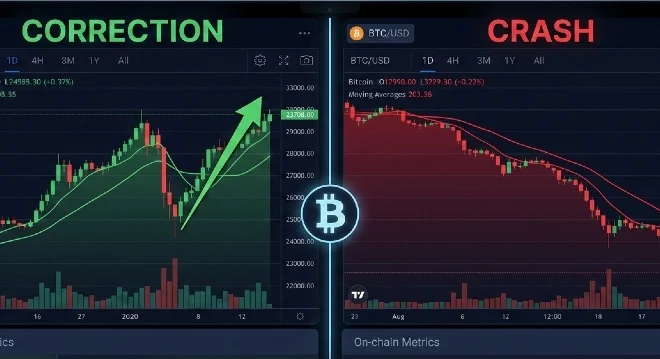
What Separates a Correction From a Full Bear Market
Not every Bitcoin crash is the beginning of a multi-year bear market. Distinguishing between them — while you’re inside one — is genuinely difficult. But there are patterns worth knowing.
Corrections within bull markets tend to be sharp and relatively brief. 20–40% drops over days or weeks, then recovery. They’re driven primarily by leverage liquidations and short-term sentiment shifts. The underlying demand structure — increasing holders, growing adoption, positive macro — remains intact.
Bear markets are different in character. They’re driven by a combination of macro tightening, deteriorating fundamentals (exchange failures, regulatory crackdowns, major project collapses), and a sustained exit of participants from the market entirely. They last long enough that they change the composition of who holds Bitcoin — flushing out the newer, less-committed holders and concentrating supply in long-term believers.
The clearest signal of a genuine bear market, historically, is when price falls below the 200-week moving average — a long-term trend line that has historically marked the deepest floor of each cycle. During the 2018–2019 bear market and the 2022 bear market, Bitcoin breached this level briefly before recovering. Staying below it for extended periods would be a genuinely bearish structural signal.
In mid-2024, this average sat somewhere around $35,000–$40,000. With Bitcoin above $100,000, there is significant cushion. A correction back to $60,000–$70,000 would feel brutal from current prices but would still represent a market in fundamental health by this measure.
The FTX Lesson Is Still Being Processed
It’s worth dwelling on FTX for a moment because its implications are still unfolding.
Sam Bankman-Fried built the second-largest crypto exchange in the world. He cultivated relationships with regulators, donated to political campaigns, was featured on the cover of Forbes. The company collapsed in days when it emerged that customer funds had been used for trading on a sister hedge fund without consent or disclosure.
Over $8 billion in customer funds were lost. SBF was convicted on seven counts of fraud and sentenced to 25 years.
The lesson isn’t just “exchanges can fail.” The lesson is that the most legitimate-seeming, most regulation-friendly, most publicly trusted entity in the space was concealing a fundamental betrayal of its users. The surface presentation was entirely disconnected from the reality underneath.
This hasn’t been fully priced into how people think about crypto counterparty risk. The instinct after FTX should be toward self-custody — holding Bitcoin in wallets where the private keys are controlled personally, not by any third party. Hardware wallets (Ledger, Trezor) exist precisely for this. The brief inconvenience of self-custody is a trivial cost compared to the risk of trusting an institution with no deposit insurance and opaque internal controls.
This isn’t a “do this” prescription — it’s analysis. The data from FTX showed that custodial risk is not theoretical. It materialized at scale, visibly, in a single week.
The Crash Nobody Talks About: Stablecoins and Contagion
The May 2022 Terra/Luna collapse is one of the most important events in crypto history and doesn’t get enough attention in mainstream analysis.
Terra was a stablecoin ecosystem — UST was supposed to maintain a $1 peg algorithmically, backed by LUNA tokens rather than actual dollars. This worked as long as confidence held. When it broke, it broke catastrophically. UST depegged. LUNA collapsed from $80 to fractions of a cent in days. Over $40 billion in market value evaporated.
This matters for Bitcoin because the contagion from Luna’s collapse spread across the entire market. Crypto lending firms like Celsius and Three Arrows Capital had significant exposure to the Terra ecosystem. They failed. Their failures triggered further selling. Bitcoin, which had nothing to do with Terra directly, dropped from $40,000 to $20,000 within weeks.
This is the interconnection problem that Bitcoin’s “digital gold” narrative doesn’t fully address. Bitcoin is technically separate from the rest of the crypto ecosystem. But the ecosystem around it — exchanges, lending protocols, stablecoins, leveraged products — creates channels through which failures in unrelated projects can create forced selling of Bitcoin. Contagion doesn’t respect asset quality.
This dynamic is somewhat reduced in the current cycle, as many of the most dangerous over-leveraged entities from 2021–2022 no longer exist. But new ones have almost certainly formed in their place, and they won’t be visible until they fail.
The Question Serious Analysts Are Actually Asking
The surface-level crash question is “how far can it fall.” The more interesting question is “what does Bitcoin’s behavior in the next crisis tell us about what it actually is.”
If Bitcoin holds relatively well during the next significant equity market selloff — if the correlation with the Nasdaq breaks down and Bitcoin behaves more like gold — that would be meaningful evidence that the narrative has shifted. That institutional participation has changed the character of the asset. That it’s genuinely becoming a store of value and not just a high-volatility risk trade.
If Bitcoin drops 60–70% alongside equities in the next recession — following the 2022 pattern — it tells a different story. It says the institutional adoption, the ETFs, the Wall Street interest, didn’t fundamentally change how Bitcoin behaves under acute stress. That it remains, for now, a speculative asset that people sell when they need liquidity.
Neither outcome is settled. Both are plausible. The next major downturn will be one of the most informative events in Bitcoin’s history — not for its price, but for what the price behavior reveals about what Bitcoin has actually become.
That’s the thing about crashes. They don’t just destroy value. They produce information. And sometimes, that information is more valuable than whatever was lost.
The Last Thing Worth Saying
Bitcoin has outlived more than 400 official declarations of its death. That’s not a marketing line — someone actually tracks these at 99bitcoins.com.
It survived the Silk Road association, Mt. Gox, the 2018 crash, China’s mining ban (twice), multiple exchange collapses, and a sustained regulatory assault that hasn’t produced a knockout blow.
Each crash produced a cleaner, less-leveraged, more conviction-driven holder base. Each crash flushed out the speculative excess that had built up in the cycle. Each crash, in retrospect, was the market taking a breath.
Whether that pattern holds one more time, or whether something fundamentally breaks it — that’s the question. It’s an honest question without a predetermined answer.
What’s clear is that the people who come out ahead after Bitcoin crashes are generally the ones who understood what they owned before the crash happened. Not in terms of price targets or technical analysis. In terms of what Bitcoin actually is, why it exists, what it’s trying to solve, and what the real risks are.
Price is temporary. Understanding is durable.

Financial Analyst Iqra Zahoor provides data-driven crypto analysis & strategies. Guiding you from market trends to informed investment decisions.