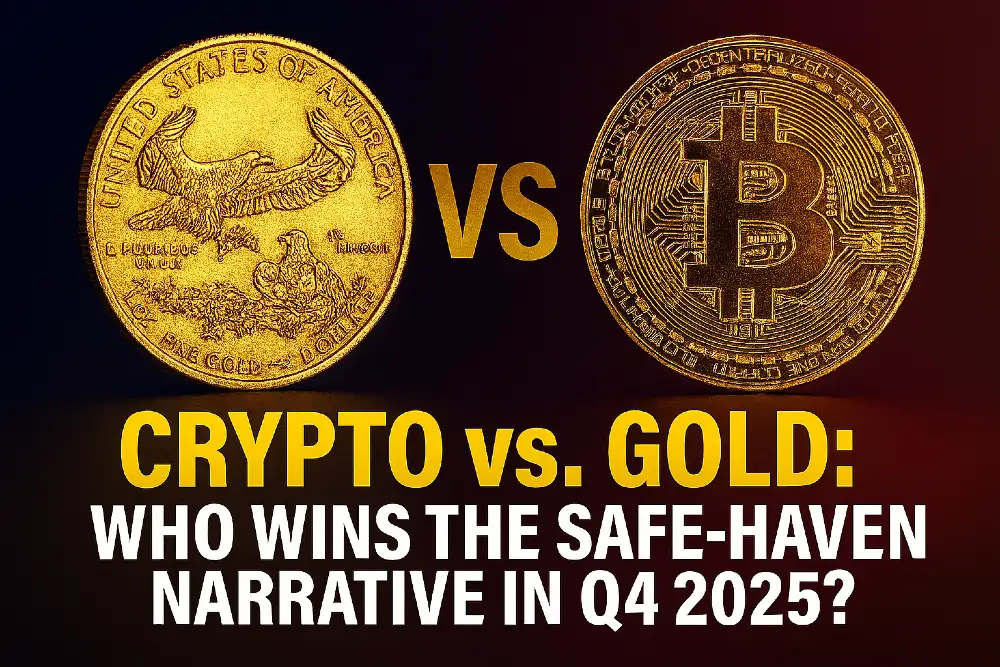
Crypto vs. Gold: Who Wins the Safe-Haven Narrative in Q4?
Every time markets get nervous — inflation ticks up, interest rates shift, geopolitical tension flares — the same conversation starts. People start asking where to park value. Where does money go when everything else feels shaky?
For centuries, the answer was gold. No debate. No competition. Just gold.
Then Bitcoin showed up and started making the same argument.
Now, heading into Q4, the question isn’t just which asset performs better. It’s deeper than that. It’s about which narrative holds — and why that narrative is being tested harder than ever.
The Safe-Haven Label: What It Actually Means
“Safe haven” is a term that gets thrown around loosely. Let’s pin it down.
A safe-haven asset is something people move money into during uncertainty — not because it grows fast, but because it’s expected to hold value, or at least lose less than everything else. The three properties traditionally required are:
- Scarcity — limited supply, can’t be inflated away
- Liquidity — you can actually sell it when you need to
- Trust — enough people agree it has value that the agreement sustains itself
Gold has all three, built over thousands of years. Bitcoin claims all three too — but the “trust” part is still being negotiated in real time. That negotiation is what Q4 2024 and beyond is really about.
Gold’s Case: Old, Boring, and Quietly Relentless
Here’s what most crypto enthusiasts don’t like to admit: gold had a historic year.
In 2024, gold crossed $2,700 per ounce — an all-time high. Central banks around the world, particularly in China, Russia, India, and Turkey, were buying gold aggressively. Not as a speculative bet. As a hedge against dollar-denominated risk, against geopolitical instability, against the possibility that the US financial system’s global dominance slowly erodes.
That’s a different kind of buyer than a retail investor trying to time a market cycle. Central banks don’t panic sell. They accumulate quietly over years. And when central banks are the buyers, the floor gets very solid.
Gold’s volatility in 2024 was also strikingly low compared to Bitcoin. It moved up steadily, without 30% drawdowns, without exchange collapses dragging it down, without tweet-driven weekend crashes. It just… climbed.
For pension funds, sovereign wealth funds, and family offices managing generational wealth — that profile is exactly what they want. Predictable, boring, and appreciating. Safe haven, by definition.
Bitcoin’s Case: The Narrative Is Maturing Faster Than Expected
Bitcoin entered 2024 from a position of credibility it didn’t have in previous cycles.
The January ETF approvals changed the institutional landscape completely. BlackRock’s iShares Bitcoin Trust pulled in billions within weeks. Fidelity, Invesco, Franklin Templeton — all running Bitcoin products now, accessible through the same brokerage accounts where someone manages their retirement portfolio.
This matters for the safe-haven argument more than price. Because when a pension fund allocates 1% of its holdings to Bitcoin through a regulated ETF product, it’s not gambling. It’s diversifying. And diversification into Bitcoin signals something: the institution sees it as a distinct asset class with a legitimate role in a portfolio.
The April 2024 halving reinforced the supply narrative. Bitcoin’s issuance dropped to 3.125 BTC per block. The math gets tighter every four years. And unlike gold — where new deposits can theoretically be discovered, where asteroid mining is a distant but real possibility — Bitcoin’s scarcity is encoded in software that 15,000+ nodes around the world are enforcing simultaneously. The cap of 21 million is arguably more reliable than any natural resource limit.
Then Bitcoin crossed $100,000 for the first time. That number is psychological, but psychology drives markets. It resets the reference point for what Bitcoin “is” in people’s minds.
Energy consumption, financial inclusion, and sanctions evasion debates. Contextualize with privacy coin risks for balanced perspective.
Where the Narratives Collide in Q4
Q4 is interesting because multiple forces converge.
Historically, Q4 has been strong for Bitcoin. The October–December period has produced significant gains in multiple past cycles — particularly in post-halving years. Traders and analysts watch this seasonality closely.
Gold tends to perform in Q4 as well, partly because institutional portfolio rebalancing at year-end increases demand, and partly because Q4 often brings macroeconomic announcements — Fed decisions, inflation data, geopolitical flare-ups — that send cautious money toward hard assets.
So both assets want the same quarter. But they attract different types of uncertainty.
When inflation is the primary fear — gold wins historically. Inflation is a slow, grinding threat. Gold is a slow, grinding hedge. The correlation has decades of data behind it.
When fiat currency itself is the fear — Bitcoin starts winning the argument. If the concern isn’t just “the dollar loses purchasing power” but “the dollar-dominated financial system becomes unreliable” — Bitcoin’s non-sovereign nature becomes genuinely relevant, not just philosophically interesting.
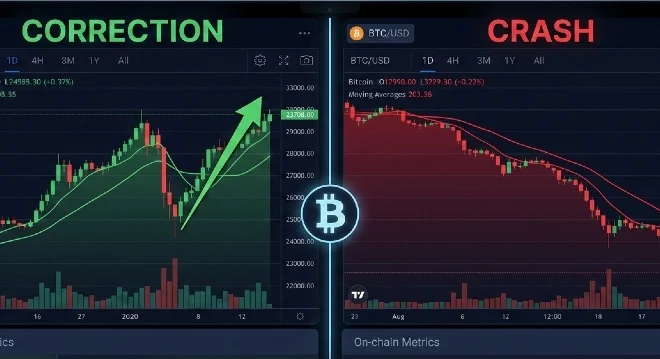
When volatility and market stress are the fear — gold wins cleanly. During the COVID crash of March 2020, Bitcoin dropped 50% in two days. Gold dropped about 10% briefly, then recovered and rose. When people panic, they don’t run toward Bitcoin — not yet, anyway. They run toward things they have trusted for decades.
This is the central tension: Bitcoin’s long-term narrative is powerful, but its short-term behavior under acute stress still doesn’t match what a “safe haven” technically requires.
Every crash spawns obituaries—historical recovery patterns suggest otherwise. Study Bitcoin history from 2009 for perspective.
The Correlation Problem Bitcoin Hasn’t Solved
One of Bitcoin’s persistent challenges to the safe-haven label is correlation.
During risk-off periods — when equity markets sell off sharply — Bitcoin tends to sell off too. Not always. Not perfectly. But often enough that the data shows a meaningful positive correlation between Bitcoin and the Nasdaq, particularly during the 2021–2022 cycle.
Why? Because a significant portion of Bitcoin holders are also equity investors. When portfolio stress hits, people liquidate what’s liquid. Bitcoin is extremely liquid. So it gets sold along with tech stocks during a crisis.
Gold, by contrast, shows consistent negative or near-zero correlation with equities during stress periods. That’s precisely the property institutions want from a hedge. When everything else falls, gold holds or rises. Bitcoin has not reliably demonstrated that behavior yet.
This doesn’t make Bitcoin a worse asset. It just means it’s a different asset — currently behaving more like high-risk, high-return technology exposure than a classical safe haven, even though the underlying monetary argument for it is genuinely sound.
The gap between Bitcoin’s narrative and Bitcoin’s observed behavior during stress is the most honest thing to acknowledge about this debate.
DEXs, P2P, and privacy-preserving acquisition methods. Verify counterparty safety using contract address verification.
Generational Divide: Who Trusts What
There’s a human element to this that doesn’t show up in price charts.
Younger investors — broadly speaking, millennials and Gen Z — have more natural trust in Bitcoin than in gold. They grew up in digital environments. They’ve watched governments and central banks do things that seemed impossible (negative interest rates, quantitative easing on unprecedented scales, direct money printing during COVID). They don’t have a lifelong relationship with gold as a physical object of value. To them, Bitcoin’s properties — verifiable, portable, scarce, borderless — feel more intuitive than digging metal out of the ground.
Older institutional money, family offices, and traditional wealth managers have the opposite relationship. They’ve watched gold perform across decades, across crises, across collapses. The 2008 financial crisis sent gold to all-time highs. The European debt crisis sent gold up. These investors watched it happen in real time. Bitcoin was a spreadsheet footnote back then.
Neither group is wrong. They’re drawing on different lived experiences of what “reliable” looks like.
This generational dynamic is one of the least-discussed factors in the safe-haven debate — and probably one of the most important for where the narrative goes over the next decade.
Verify token authenticity before swapping to avoid honeypots. Acquire assets safely even when buying without SSN.
The Lightning Network and Gold’s Liquidity Problem (An Underrated Comparison)
Here’s an angle most analysis skips: practicality as money.
Gold is a terrible medium of exchange. You can’t send gold across a border in seconds. You can’t divide it into tiny fractions easily. Physical gold requires storage, insurance, and trust in custody providers. Even “paper gold” (ETFs and futures) requires intermediaries.
Bitcoin, especially through the Lightning Network — a payment layer built on top of Bitcoin that allows near-instant, near-zero-fee transactions — is increasingly functional as actual money. You can send $0.02 worth of Bitcoin to someone in another country in under a second. That’s not theoretical anymore. That works today.
If the safe-haven conversation eventually evolves toward “which asset also functions as a usable currency during crisis” — Bitcoin’s answer becomes much stronger than gold’s. Gold wins at storing value over centuries. Bitcoin might win at moving value during crises.
The irony is that Bitcoin was designed as electronic cash first, and the store-of-value argument came later. Gold was a store of value first, and its use as a practical currency died long ago. They’re almost heading in opposite directions.
Licensing, liquidity, and custody infrastructure requirements. Understand how exchanges function before building your own.
Q4 2024: What Actually Happened (And What It Tells Us)
Bitcoin ended 2024 above $100,000. Gold ended 2024 near $2,600–2,700. Both assets hit all-time highs in the same year. That almost never happens simultaneously — it suggests a broader flight away from fiat-denominated assets rather than a competition between the two.
That’s actually the most important data point of the year: both won. Not against each other. Both won against cash, against bonds, against the assumption that the traditional financial system is fully functioning and trusted.
The market wasn’t choosing between crypto and gold. The market was choosing hard assets over soft ones.
This reframes the entire “who wins the safe-haven narrative” question. Maybe the premise is wrong. Maybe it’s not a competition. Maybe sophisticated allocators are watching both rise and concluding that the real loser in Q4 is the dollar.
The Argument Against Both
It’s worth pausing here. Because neither asset is without serious counterarguments.
Against gold: Its industrial use is limited. Its price is heavily influenced by currency movements and futures markets, not purely supply-demand fundamentals. A portion of gold’s price is narrative-driven too — it just has a longer narrative. Central bank buying is powerful, but it’s also opaque, and reversals can happen.
Against Bitcoin: The volatility problem isn’t solved. Regulatory risk in major markets remains real — a coordinated global regulatory crackdown, while unlikely, isn’t impossible. The energy consumption debate creates political and ESG headwinds for institutional adoption. And the fact that Satoshi’s 1 million coins sitting unmoved represents a potential supply shock that nobody can predict.
Both narratives have weaknesses. The ones that tend to “win” over time are the ones where the weaknesses matter less than the strengths — and where enough people agree that the story is worth defending.
Where This Debate Stands Heading Into the Next Cycle
Gold has roughly a $13–14 trillion market cap. Bitcoin’s is around $1.8–2 trillion (at $100k+ prices). For Bitcoin to truly challenge gold as the dominant safe-haven asset, it needs to grow significantly — and more importantly, it needs to demonstrate that correlation-with-equities property breaking down during real stress events.
The next major test won’t be a bull market. Bull markets are easy for any asset. The test will be the next genuine crisis — recession fears, a credit event, a geopolitical shock — and how Bitcoin behaves in that moment compared to gold.
If Bitcoin holds relatively well during the next serious selloff, the safe-haven narrative gains real evidence. If it drops 60% while gold rises, the narrative gets pushed back another cycle.
That test hasn’t happened yet under the current institutional framework — with ETFs, with this level of adoption, with this regulatory clarity. It’s genuinely new territory.
The Most Honest Conclusion
There is no clean winner here. Anyone telling you there is — is selling something.
Gold has millennia of trust, central bank backing, and crisis-tested behavior. It does what a safe haven is supposed to do in short-term stress. It’s boring in the best way possible.
Bitcoin has the stronger long-term monetary argument, the superior scarcity guarantee, and is being adopted by institutions in ways that were unimaginable five years ago. Its ceiling, if the narrative holds, is higher than gold’s. Its floor, if it doesn’t, is lower.
The safe-haven narrative in Q4 and beyond isn’t being won by one asset. It’s being shared — awkwardly, in negotiation — between the old world’s most trusted store of value and the new world’s most compelling monetary experiment.
And both of them, for now, are winning against the thing neither of them is: cash.