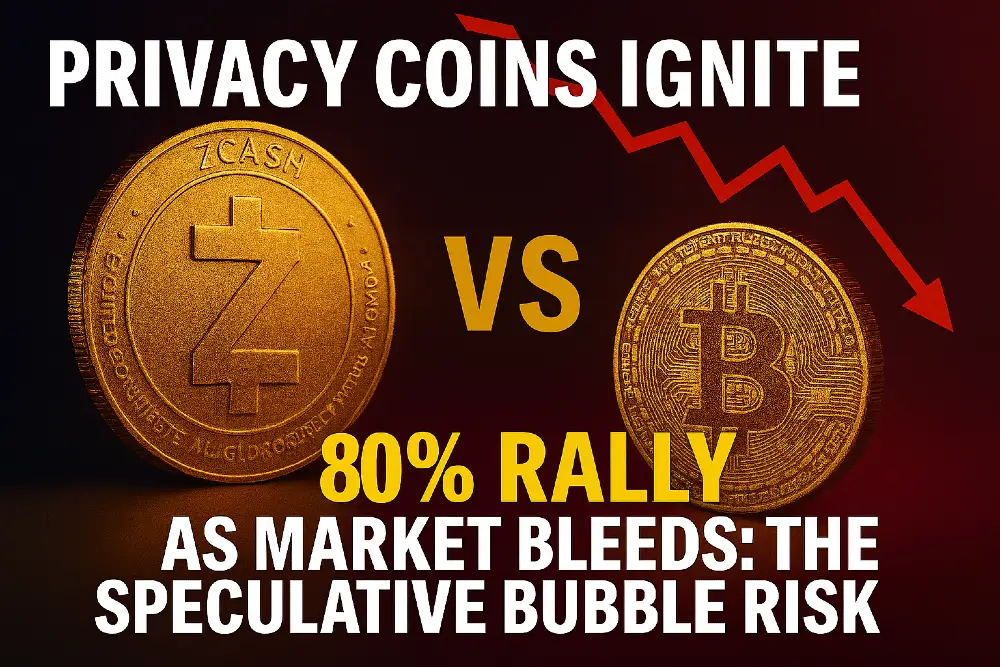
Privacy Coin Sparks 80% Rally as Market Bleeds
When the broader crypto market is selling off, most assets move in one direction — down. Correlated. Together. Which is exactly why it catches people’s attention when something moves the other way.
A privacy coin posting an 80% rally during a market-wide bleed isn’t noise. It’s a signal worth reading carefully — not just for traders watching charts, but for anyone trying to understand what’s actually driving money in crypto right now and why.
These counter-trend moves have their own logic. They don’t happen randomly. They happen because a specific narrative, catalyst, or structural shift creates demand for exactly what that asset offers — at precisely the moment the market’s mood would suggest otherwise.
Privacy coins are having that moment. The reasons are layered.
What Privacy Coins Actually Are — and Why Most People Misunderstand Them
The popular understanding of privacy coins goes something like this: anonymous money, used by criminals, banned by exchanges, destined for regulatory oblivion.
That story is incomplete to the point of being misleading.
Privacy coins are cryptocurrencies that obscure transaction data — the sender, the receiver, the amount — that would otherwise be publicly visible on a standard blockchain. Bitcoin, for all its reputation for anonymity, is actually radically transparent. Every transaction ever made is permanently visible on the blockchain. With enough blockchain analytics work, the identity behind a Bitcoin wallet can often be determined. Law enforcement has demonstrated this repeatedly.
Privacy coins solve a different problem. They’re built for financial privacy — the same privacy that exists in cash transactions, that existed before digital payments turned every purchase into a data point collected by banks, payment processors, and advertisers.
Monero (XMR) is the oldest and most technically mature. It uses three mechanisms simultaneously: Ring Signatures (which mix a user’s transaction with others to obscure the sender), Stealth Addresses (one-time addresses generated for each transaction, so the receiver’s address is never publicly linked), and RingCT (which hides the transaction amount). The result is a blockchain where transactions are verifiable as legitimate but opaque in their specifics. Even blockchain analytics firms that specialize in tracing crypto transactions have acknowledged Monero as effectively untraceable with current technology.
Zcash (ZEC) takes a different technical approach using zk-SNARKs — zero-knowledge proofs that allow a transaction to be verified as valid without revealing any of its details. Zcash has both transparent (public) and shielded (private) transaction types. The privacy is optional — which has been both a strength (regulatory flexibility) and a weakness (most Zcash transactions are actually transparent, undermining the privacy value in practice).
Dash (DASH) offers an optional privacy feature called CoinJoin — a mixing mechanism that pools transactions from multiple users to obscure individual inputs and outputs. It’s the weakest privacy implementation among the major privacy coins and arguably doesn’t belong in the same technical category as Monero or Zcash.
Newer entrants worth watching: Firo (ZCOIN), which uses a cryptographic protocol called Lelantus Spark that allows direct anonymous transactions. Beam and Grin both implement MimbleWimble — a blockchain protocol that strips all transaction data except what’s needed for validation, compressing the chain while eliminating observable transaction history.
Layer-1 protocols and DeFi blue chips ranked by risk-adjusted potential. Avoid FOMO by studying why crypto crashes before allocating capital.
The 80% Move: What’s Behind It
Counter-trend rallies in individual assets during market-wide selloffs have specific causes. They’re almost never just technical. Something fundamental has to shift in how the market perceives that asset’s near-term value proposition.
For privacy coins, several converging forces have built up pressure that’s now releasing.
The regulatory pendulum is swinging. The past three years were characterized by aggressive regulatory posture toward crypto globally — and privacy coins specifically. Multiple major exchanges delisted privacy coins under regulatory pressure. Bittrex, Kraken (in some jurisdictions), and several others removed Monero or restricted Zcash in response to compliance requirements from regulators in the US, EU, Japan, and South Korea.
But regulatory environments aren’t static. In the US, the political and regulatory climate shifted meaningfully through 2024. The SEC’s aggressive stance on crypto broadly — which contributed to overall market depression — began meeting resistance. Court cases went against the SEC. Congress started moving toward clearer legislative frameworks rather than enforcement-first approaches. A more crypto-friendly regulatory environment reduces the binary risk that had been priced into privacy coins: “these get completely banned.”
When that ban risk diminishes, even partially, the suppressed value starts recovering.
CBDC anxiety is a real driver. Central Bank Digital Currencies — government-issued digital money that operates on a government-controlled blockchain — are in various stages of development across dozens of countries. China’s digital yuan is already deployed. The EU is developing the digital euro. The US Federal Reserve has conducted research into a digital dollar.
CBDCs are designed for surveillance. Every transaction traceable. Spending patterns visible to governments. Financial behavior monitorable in real time. The policy rationale is tax compliance, anti-money laundering, and monetary control. The civil liberties concern is obvious.
As CBDC development accelerates, a portion of the population — not just criminals, but privacy-conscious individuals, dissidents in authoritarian countries, people in economies with histories of government asset seizure — is increasingly interested in financial tools that CBDCs cannot monitor.
Privacy coins are the most direct technological answer to that concern. CBDC rollout news has repeatedly correlated with privacy coin price movements. This rally has that fingerprint on it.
The broader market bleeds while privacy flows in. When standard crypto assets sell off, they sell off because risk appetite decreases. Institutional investors reduce exposure. Leveraged positions get liquidated. People move to stablecoins or exit crypto entirely.
But the buyers of privacy coins in a down market are often a different category of buyer — people seeking privacy infrastructure specifically, not general crypto exposure. They’re not exiting because of market fear. They’re entering because the conditions (surveillance anxiety, CBDC development, regulatory uncertainty in their home country) have become more pressing, not less.
Counter-trend buyers in a bleeding market are conviction buyers. They’re not momentum traders following price up. They’re accumulating specifically because of what the asset does.
CBDCs, tokenized securities, and decentralized identity converge by 2030. Ground predictions in Bitcoin’s complete history of disruption cycles.
The Monero Story Specifically
Monero deserves its own section because it’s the asset that most consistently demonstrates real privacy coin dynamics — as opposed to the coins that market privacy as a feature while delivering something weaker.
XMR’s price has historically been less correlated with Bitcoin than almost any other major crypto asset. That’s unusual and worth understanding. Most altcoins move with Bitcoin — when BTC goes up, they go up. When BTC falls, they fall harder. Monero has periods where it decouples entirely, driven by its own demand dynamics.
Part of this is the buyer profile. Monero is used — actually used, not just held speculatively — by people who need financial privacy. Journalists in authoritarian countries. Activists. Privacy advocates. People in economies experiencing currency controls. Darknet markets, yes, but that’s a fraction of usage and also demonstrates something: Monero actually works. It’s not a theoretical privacy solution. It functions in practice.
This usage creates baseline demand that isn’t purely speculative. When the market sells off and speculative demand evaporates from other assets, Monero’s utility-based demand floor doesn’t move as much.
The delisting narrative around Monero is worth reexamining too. When Kraken delisted XMR in the UK, it was widely reported as a death sentence for the asset. Price dropped. Then recovered. Then exceeded pre-delisting levels. Because the people who actually use Monero for privacy don’t primarily hold it on centralized exchanges — they hold it in wallets they control. Centralized exchange delistings affect the marginal speculative buyer more than the core user base.
This also creates an asymmetry. When privacy coins get relisted on exchanges as the regulatory environment improves, the speculative buyer base returns — but the core user base was never gone. Relisting adds buyers on top of a floor that was maintained through the delisting period.
Digital gold competes with world computer thesis—divergent value propositions. Expand to all cryptocurrency types for full market context.
Zero-Knowledge Proofs: The Technology That Changes the Conversation
The technology behind Zcash — zk-SNARKs — deserves more attention than it typically gets in privacy coin coverage, because it’s become far more relevant than privacy coins alone.
A zero-knowledge proof allows one party to prove to another that a statement is true without revealing any information beyond the validity of the statement itself. The classic illustration: you can prove you know the solution to a maze without showing the path you took.
In crypto, this means: you can prove a transaction is valid (the sender has the funds, the amounts are correct, no double-spending) without revealing the sender, receiver, or amount. Zcash uses this for private transactions.
But zk-proofs have exploded beyond privacy coins entirely. They’re now the foundational technology behind the most important Ethereum scaling solutions — zkSync, StarkNet, Polygon zkEVM. These Layer 2 networks use zero-knowledge proofs to batch hundreds of transactions and submit a single proof to Ethereum’s mainnet, dramatically reducing gas fees and increasing throughput.
The reason this matters for the privacy coin narrative: zk-proof technology is no longer “fringe privacy tech for people avoiding surveillance.” It’s mainstream blockchain infrastructure. The biggest, most well-funded teams in Ethereum development are building with it. The technology itself is gaining legitimacy, and that legitimacy bleeds back into the original privacy coin use case.
When regulators and institutions start understanding zk-proofs as a scaling technology, their framing of the technology shifts. It becomes harder to categorize the entire zk-proof ecosystem as “criminal infrastructure” when the same cryptographic tools are being used to scale Ethereum for institutional finance applications.
Pizza purchases, Silk Road, and institutional adoption—evolution of narrative. Apply lessons to current crypto tanking events with historical perspective.
The Regulatory Tightrope: Why Privacy Coins Aren’t Dead
Every year for the past five years, there has been some version of “this might be the end for privacy coins” in crypto media. A delisting. A regulatory statement. A proposed bill. An exchange compliance crackdown.
And every year, privacy coins persist.
The reason isn’t that regulators lack the power to act. It’s that the legal and philosophical framework for banning financial privacy is more contested than the enforcement headlines suggest.
The Financial Action Task Force (FATF) — the global standard-setter for anti-money laundering rules — has issued guidance that puts privacy coins in a difficult compliance position. Exchanges operating in jurisdictions that follow FATF guidance face pressure to either delist or require transparent transaction histories for privacy coins.
But FATF guidance is not law. National regulators translate it into law differently. And within the EU, the US, and elsewhere, there are active legal debates about whether blanket restrictions on privacy technology are proportionate, enforceable, or constitutionally sound.
The US has a strong tradition of financial privacy protections — eroded over decades by Bank Secrecy Act requirements, but not eliminated. Cases involving cryptocurrency privacy have produced mixed results. In the Tornado Cash case (an Ethereum mixing service sanctioned by OFAC), courts have been divided on whether sanctioning open-source software that runs autonomously on a blockchain is constitutional. One court ruled in favor of OFAC. An appeals court partially reversed, finding that immutable smart contracts can’t be “property” of a sanctioned entity.
These legal ambiguities matter for privacy coins because they show the regulatory picture is genuinely contested, not settled. The “privacy coins are inevitably banned” narrative was always an oversimplification. The legal fights are real, ongoing, and not predetermined.
Portability and auditability versus 5,000 years of trust—trade-offs analyzed. Implement allocation using APY optimization strategies for yield-bearing portions.
Firo and MimbleWimble: The Underfollowed Privacy Narrative
Beyond Monero and Zcash, a less-followed privacy layer is worth attention.
Firo (formerly Zcoin) deployed the Lelantus Spark protocol, which allows coins to be burned and reissued as new, fully anonymous coins with no transaction history. The mechanism is arguably cleaner than Monero’s ring signature approach from a cryptographic standpoint, though Monero’s network effects and adoption remain far larger.
MimbleWimble — named after a fictional tongue-tying curse from Harry Potter — is a blockchain design where transaction data is eliminated entirely once a transaction is confirmed. There are no addresses in MimbleWimble, no input/output history. The chain compresses to a fraction of Bitcoin’s size. Grin implements this as a pure MimbleWimble chain. Beam adds scripting capabilities on top.
Both remain small by market cap but represent genuine technical differentiation. If privacy becomes a more mainstream demand — driven by CBDCs, surveillance capitalism, or political repression in various countries — these are the rails that could carry that demand.
Stablecoin reserves and DCA schedules for systematic accumulation. Recognize patterns using technical downtrend indicators for timing.
Who Is Actually Buying in a Down Market
The demographic of privacy coin buyers during a broad market selloff is not a typical crypto buyer profile.
Crypto’s mainstream retail buyers are momentum-driven. They come in during bull markets when friends and media are talking about gains. They leave during bear markets when the conversation turns negative. This is normal human behavior and explains why most altcoins correlate so tightly with Bitcoin’s cycle.
Privacy coin buyers during market stress tend to include:
People responding to news events — a CBDC announcement, a government surveillance revelation, a banking restriction in a specific country. These buyers are reacting to real-world events, not price charts.
Long-term ideological holders — the cypherpunk tradition that predates Bitcoin itself. People who believe financial privacy is a fundamental right and hold privacy coins as a reflection of that belief rather than a trade.
Hedge funds and sophisticated traders who notice the counter-trend divergence and see it as asymmetric opportunity — if the market recovers, privacy coins participate. If the market stays stressed, the privacy demand thesis gets stronger.
Geographic demand clusters — countries experiencing currency crises, capital controls, or authoritarian overreach consistently produce privacy coin buying. Nigeria, Argentina, Venezuela, Iran. Not because people there are criminals, but because financial privacy is genuinely protective in those environments.
This buyer mix creates a demand profile that doesn’t track perfectly with the broader crypto market. It’s driven by utility and ideology in ways that Bitcoin itself was in its early years — before it became a liquid institutional asset and took on macro sensitivities.
Consensus layer assets differ from application-layer utilities—taxonomy matters. Start with Ethereum vs Bitcoin comparison for foundational understanding.
The Counter-Narrative Worth Taking Seriously
No analysis is complete without the honest counter-argument.
Privacy coins face existential regulatory risk that is real, not hypothetical. Japan, South Korea, and Australia have effectively banned or severely restricted privacy coin trading through exchange regulation. If the EU’s MiCA framework evolves to require transaction traceability — which is a live policy debate — European exchange listings for privacy coins could become impossible.
Without exchange listings, retail liquidity dries up. Without retail liquidity, the speculative premium disappears. What remains is the core utility user base — potentially significant, but likely much smaller than the speculative market cap implies.
There’s also a technical risk specific to Monero that rarely gets discussed openly: Monero’s privacy rests on cryptographic assumptions that could theoretically be broken by sufficiently advanced computing — including, eventually, quantum computing. Monero’s development team is aware of this and working toward post-quantum cryptography upgrades. But it’s a long-term structural risk that other assets don’t carry in the same way.
And there’s the exchange delisting spiral concern. If major exchanges continue removing privacy coins as a compliance default, the price discovery mechanism weakens. OTC and DEX markets fill some of that gap, but not all of it. The visibility and accessibility that exchange listings provide are real components of an asset’s value.
What an 80% Move in a Bleeding Market Actually Means
Price movements this sharp, in this direction, against this backdrop, are telling you something.
An 80% rally when the market is bleeding isn’t randomness. It reflects concentrated, conviction-driven buying in an asset that has a specific story the broader market doesn’t. The buyers aren’t waiting for conditions to improve. They’re acting because they believe the conditions are exactly right for what this asset offers.
Whether that conviction proves correct depends on whether the catalysts are durable. CBDC development isn’t stopping. Surveillance of financial transactions isn’t decreasing. Regulatory clarity in major markets is improving in ways that reduce the delisting risk that had suppressed these assets.
If those forces continue — and the structural case suggests they will — the counter-trend move in privacy coins isn’t a temporary anomaly. It’s the beginning of a repricing of what financial privacy is worth in a world that increasingly lacks it.
That’s a larger story than an 80% rally. The rally is just where it became visible.

Financial Analyst Iqra Zahoor provides data-driven crypto analysis & strategies. Guiding you from market trends to informed investment decisions.