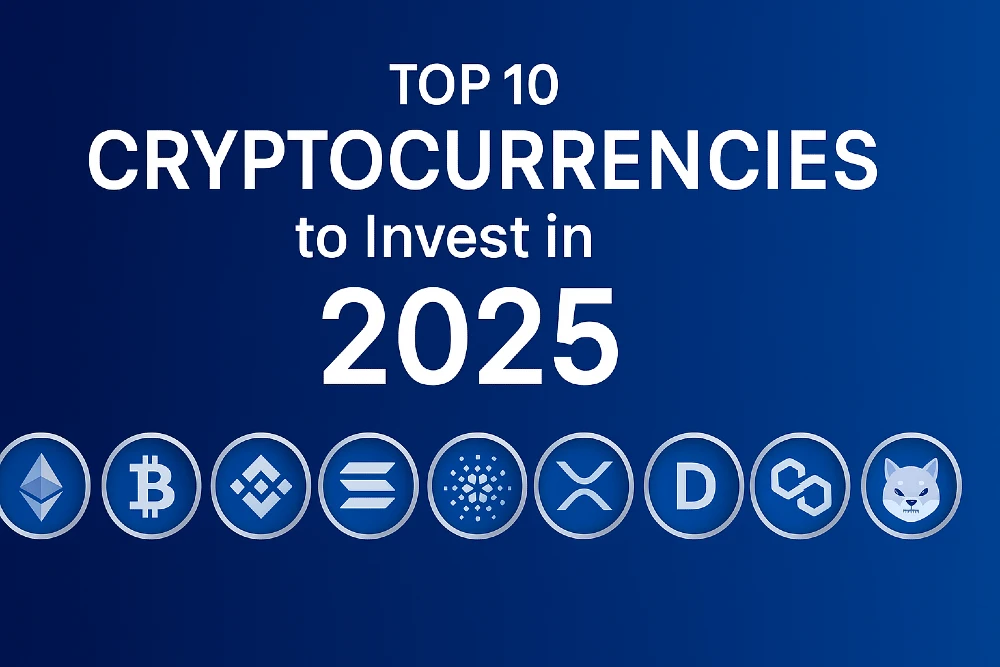
Top 10 Cryptocurrencies to Invest in 2026
Most people searching this topic want one thing: a clear list of which coins are actually worth putting money into right now — not a history lesson about Bitcoin or a glossary of crypto terms.
So here it is, directly: Bitcoin, Ethereum, Solana, BNB, XRP, Avalanche, Chainlink, Sui, Render, and Hyperliquid are the 10 cryptocurrencies that carry the strongest investment case going into 2026 — based on real utility, network activity, developer adoption, and tokenomics. Not hype.
This guide explains each one practically: what it does, why it matters right now, what the real risk is, and what you should actually do with it.
Crypto Best For Risk Level 2026 Catalyst Bitcoin (BTC) Long-term store of value Low–Medium Post-halving supply squeeze Ethereum (ETH) DeFi, smart contracts Medium ETH ETF inflows + staking yield Solana (SOL) Fast dApps, trading Medium–High DePIN + memecoin ecosystem growth BNB BNB Chain ecosystem use Medium Launchpad + burn mechanism XRP Cross-border payments Medium Regulatory clarity + RLUSD stablecoin Avalanche (AVAX) Institutional subnets Medium–High Evergreen subnet enterprise deals Chainlink (LINK) Oracle infrastructure Medium CCIP cross-chain protocol adoption Sui (SUI) Next-gen DeFi & gaming High Object-based model attracting devs Render (RNDR) Decentralized GPU compute High AI + GPU demand surge Hyperliquid (HYPE) On-chain perpetuals trading High Native L1 launch + HYPE token
1. Bitcoin (BTC) — The One That Doesn’t Need Justification Anymore
Bitcoin is still the safest long-term crypto hold in 2026 because it has the lowest inflation rate of any major asset after the April 2024 halving, institutional ETF demand is pulling supply off exchanges, and its 4-year cycle pattern historically creates strong price appreciation 12–18 months post-halving.
Bitcoin crossed $100,000 in late 2024. The reason wasn’t hype — it was structural. Spot Bitcoin ETFs from BlackRock, Fidelity, and others were approved in January 2024, and those funds started buying BTC daily while total new supply dropped to 3.125 BTC per block after the halving. Less new supply entering the market. More institutional demand. That combination has historically not ended quietly.
What you need to understand about Bitcoin’s risk:
- Bitcoin can drop 30–50% in a matter of weeks during market corrections. This happened in 2021 and 2022. It will likely happen again at some point.
- It has no yield. Holding BTC gives you no staking reward, no interest. You earn only if price goes up.
- Liquidity is high, meaning you can buy and sell easily — but that also means panic selling during downturns is fast.
What to do: Buy BTC through a regulated exchange (Coinbase, Kraken, or Binance). Store it on a hardware wallet like Ledger or Trezor if you’re holding more than $1,000 worth. Never leave large amounts on an exchange.
What NOT to do: Don’t try to time Bitcoin’s price. Don’t buy all at once. Dollar-cost averaging — buying a fixed amount every week or month regardless of price — has outperformed lump-sum buying for most people who aren’t professional traders.
2. Ethereum (ETH) — The Network That Actually Gets Used
Ethereum is the foundation of the DeFi and smart contract ecosystem. In 2026, it matters because it generates real fee revenue, supports spot ETH ETFs now approved in the US, and offers staking yield — meaning you can earn passive income just by holding and staking it.
Ethereum is a programmable blockchain. That means developers can build applications directly on top of it — lending protocols, exchanges, NFT markets, stablecoins, and more. Over $60 billion in assets are locked in Ethereum’s DeFi ecosystem as of early 2026. No other blockchain comes close in total value secured.
After the Merge in 2022, Ethereum switched from proof-of-work (mining) to proof-of-stake (staking). This means ETH holders can lock their tokens to help validate the network and earn around 3–4% APY annually. Not huge, but real yield from a productive asset.
The EIP-1559 burn mechanism matters here. Every transaction on Ethereum destroys a portion of ETH permanently. During periods of high network usage, ETH becomes deflationary — meaning the total supply actually decreases. This is a structural price support mechanism that most crypto assets don’t have.
What to do: You can stake ETH directly through Lido Finance (liquid staking — you get stETH back which you can still use) or through Coinbase’s cbETH product. Minimum for solo staking is 32 ETH, which is not practical for most people — use Lido if you have less.
Risks:
- Layer 2 networks like Arbitrum and Base are taking activity away from Ethereum mainnet. This reduces fee burn and can hurt ETH’s deflationary story.
- Competition from Solana and other chains is real.
- ETH can drop significantly in a bear market even with strong fundamentals.
What NOT to do: Don’t confuse holding ETH with staking ETH. They’re different. If you’re just buying on an exchange and leaving it there, you’re not earning any yield.
3. Solana (SOL) — Speed Is Its Product
Solana processes thousands of transactions per second at fractions of a cent in fees. In 2026, it’s the most active blockchain for retail trading, memecoins, DePIN projects, and on-chain applications — making SOL one of the highest-activity networks in crypto.
Solana’s design is fundamentally different from Ethereum. Instead of requiring every validator to process every transaction sequentially, it uses a system called Proof of History — essentially a built-in clock — to parallelize transaction processing. The result: faster, cheaper transactions.
This attracted traders, developers, and recently, institutional interest. The Solana ecosystem has exploded with projects like Jupiter (the leading DEX aggregator on Solana), Jito (liquid staking with MEV rewards), and Render Network migrating partly to Solana.
DePIN is a big 2026 theme for Solana. DePIN stands for Decentralized Physical Infrastructure Networks. These are projects that use token incentives to build real-world infrastructure — wireless networks (Helium), GPU compute (Render), mapping (Hivemapper). Many of the strongest DePIN projects run on Solana.
Staking SOL: You can stake SOL directly from wallets like Phantom or Solflare. You delegate to a validator and earn around 6–7% APY. This is native staking, not a third-party protocol. Lower risk than DeFi yield farming.
Risks:
- Solana has had network outages in the past. It’s improved significantly, but uptime history is a legitimate concern.
- Heavy memecoin activity inflates network metrics temporarily and can distort how “healthy” the ecosystem looks.
- SOL is more volatile than BTC and ETH. It can drop 70–80% in a bear cycle.
What NOT to do: Don’t buy Solana memecoins expecting Solana-level stability. Memecoins on any chain are extremely high risk. The fact that the network is fast doesn’t make the tokens on it safer.
4. BNB — Binance’s Chain Has Real Utility (But One Big Risk)
Direct answer: BNB is the native token of BNB Chain (formerly Binance Smart Chain) and Binance exchange. It powers transaction fees, token launches on Binance Launchpad, and benefits from a quarterly token burn that permanently removes BNB from circulation.
BNB Chain is one of the highest-transaction-volume blockchains in crypto. It hosts thousands of DeFi protocols and is particularly popular in Asia and emerging markets where Binance is the dominant exchange.
The burn mechanism works like this: every quarter, Binance uses a portion of its profits to buy back BNB from the market and burn it. Auto-burn was introduced to make the process algorithmic and transparent. This creates consistent deflationary pressure on supply.
The risk you can’t ignore: BNB is fundamentally tied to Binance. If Binance faces major regulatory action, exchange insolvency, or a confidence crisis — like what happened to FTX in 2022 — BNB’s value would be severely impacted. This isn’t a theoretical risk. Binance’s CEO was convicted in the US in 2023 and paid $4.3 billion in fines. The exchange is operating under compliance requirements. That risk is baked in.
What to do: Use BNB primarily to reduce trading fees on Binance (you get a 25% discount when paying fees in BNB) and to participate in Binance Launchpool and Launchpad events. These give BNB holders early access to new tokens — often at below-market prices.
What NOT to do: Don’t treat BNB as a “safe” alternative to BTC or ETH. Its utility is mostly platform-dependent. If you’re not using Binance regularly, the investment case for BNB is weaker.
5. XRP — Years of Legal Battle, Now Clarity
Direct answer: XRP’s investment case in 2026 is built on regulatory clarity after Ripple’s partial legal victory against the SEC, the launch of RLUSD (Ripple’s USD-pegged stablecoin), and growing adoption of RippleNet for cross-border payments in Asia and the Middle East.
XRP is the native token of the XRP Ledger, a blockchain designed specifically for fast, cheap international transfers. A transaction on XRPL settles in 3–5 seconds and costs fractions of a cent. For context, a SWIFT bank transfer takes 1–3 business days. That speed difference is the core utility argument.
Ripple has signed agreements with banks and payment providers in Japan, UAE, and several Southeast Asian countries to use RippleNet for settlement. XRP is used as a “bridge currency” in these transactions — converting from one fiat currency to XRP and back to another fiat currency, settling in seconds.
RLUSD, Ripple’s stablecoin, launched in late 2024. This is important because it signals Ripple is building a broader payments ecosystem — not just relying on XRP speculation. RLUSD runs on both the XRP Ledger and Ethereum.
Risks:
- XRP has limited DeFi ecosystem compared to ETH or SOL. Most of its value is thesis-based, not activity-based.
- Regulatory risk outside the US is still present.
- The price can be heavily manipulated due to large retail speculator base.
What to do: If you believe cross-border payments will shift to blockchain rails in the next 5 years, XRP has a real use case. Buy and hold through Coinbase or Kraken (both list XRP). Don’t use XRP for DeFi unless you’re specifically using XRPL’s AMM, which launched in early 2024.
6. Avalanche (AVAX) — Enterprise Subnets Are the Real Story
Direct answer: Avalanche’s main strength in 2026 is its Subnet architecture — the ability to create customized, independent blockchains that plug into the Avalanche ecosystem. This is attracting institutional and enterprise clients who need compliance-controlled, high-performance blockchains.
Avalanche’s “Evergreen” subnets are pre-configured private blockchains built for financial institutions. Spruce, for example, is a compliance-focused subnet being used for tokenizing real-world assets (RWAs) like bonds and funds by firms including Deloitte and the Republic of the Marshall Islands.
Tokenized real-world assets are one of the fastest-growing sectors in crypto in 2026. BlackRock, Franklin Templeton, and others have tokenized Treasury products. Much of this is happening on Avalanche and Ethereum. AVAX benefits because every new subnet requires AVAX for gas and staking.
How AVAX staking works: You need at least 25 AVAX to run a validator node, or you can delegate to an existing validator with as little as 1 AVAX. Lock-up period is a minimum of 2 weeks, maximum 1 year. APY is around 7–9%.
Risks:
- Avalanche’s retail DeFi ecosystem has cooled significantly since 2021. Most of the activity now is institutional — which is slower to show up in price.
- AVAX has underperformed BTC and ETH in recent bull cycles on a percentage basis.
What NOT to do: Don’t expect Avalanche to behave like a high-momentum retail token. Its growth is slower and more structural. If you want fast price pumps, AVAX is the wrong choice.
7. Chainlink (LINK) — The Infrastructure Nobody Talks About Enough
Direct answer: Chainlink is the dominant oracle network in crypto. Oracles solve one critical problem: smart contracts on blockchains can’t access real-world data on their own. Chainlink feeds them that data — price feeds, weather data, sports scores, anything. Without oracles, most DeFi protocols can’t function.
Think of it this way: a lending protocol on Ethereum needs to know the current price of ETH to calculate if a loan is over-collateralized. That price data comes from Chainlink. If the oracle fails or gets manipulated, the protocol can be exploited. This is why Chainlink’s reliability is existential to DeFi.
CCIP — Cross-Chain Interoperability Protocol — is Chainlink’s 2025–2026 growth driver. It allows tokens and data to move between different blockchains securely. Major financial institutions including SWIFT have run pilots on CCIP. If cross-chain messaging becomes standard infrastructure (likely), LINK captures value as the protocol underneath it.
Staking LINK: Chainlink staking launched in v0.2 in late 2023. Stakers provide collateral that backs oracle service guarantees. APY is currently around 4–7%. This is early-stage but signals LINK is moving toward a productive asset model.
Risks:
- New oracle competitors (Pyth Network on Solana, for example) are gaining ground in specific ecosystems.
- LINK’s price has historically lagged the broader bull market — it tends to be a slow mover.
What to do: LINK is best positioned as a medium-to-long-term hold tied to DeFi and institutional blockchain adoption. If you believe both those sectors grow in 2026–2027, LINK has structural tailwinds.
8. Sui (SUI) — The Developer-First Blockchain Gaining Real Traction
Direct answer: Sui is a new-generation Layer 1 blockchain built by former Meta engineers. It uses an object-based data model (instead of an account-based model) that allows many transactions to process in parallel, without conflicting. This makes it significantly faster for complex applications like gaming and DeFi.
Sui launched mainnet in May 2023 and has grown quickly. Total value locked in Sui DeFi crossed $1 billion in late 2024. Native DEXs like Cetus and SuiSwap are growing. The Sui Foundation is actively funding developer grants.
The object model is genuinely different. On Ethereum, when you send a token, the network updates your account balance. On Sui, the token itself is an object — and you’re transferring ownership of that object. This allows independent transactions to process simultaneously without slowing each other down.
Risks:
- Sui is still early. Ecosystem is small compared to Ethereum or Solana.
- Token distribution was criticized at launch — a large portion held by insiders.
- Higher volatility, lower liquidity than top-tier assets.
What to do: If you’re willing to take higher risk for higher potential upside, Sui has a real technical foundation and active developer community. Keep position size small relative to your overall portfolio. Use Sui Wallet (official) or Suiet wallet to interact with the ecosystem.
Digital scarcity competes with millennia-tested wealth preservation. Hedge effectively using futures strategies for downside protection.
9. Render (RNDR) — GPU Demand Meets Blockchain
Direct answer: Render Network is a decentralized GPU rendering marketplace. Artists and developers who need GPU compute power for 3D rendering, AI inference, or video production can pay RNDR tokens to use idle GPUs contributed by providers around the world. In a world where GPU demand has exploded because of AI, Render has a real-world use case with growing demand.
The migration to Solana in 2023 improved Render’s transaction speed and reduced fees significantly. The network uses a burn-and-mint mechanism: RNDR is burned when jobs are paid, and new tokens are minted as rewards to GPU providers. This creates a usage-driven demand cycle for the token.
Render is part of the broader DePIN trend — decentralized physical infrastructure. The thesis is straightforward: centralized GPU clouds (AWS, Google Cloud, Azure) are expensive and often constrained. A decentralized marketplace can undercut them on price and scale faster.
Risks:
- Render depends on actual GPU job volume to sustain token demand. If job volume is low, the burn mechanism weakens.
- Competing projects like Akash Network and io.net are building similar infrastructure.
- High risk, speculative. Price is highly correlated with broader AI market sentiment.
What NOT to do: Don’t buy RNDR expecting short-term price pumps from news cycles. The value here is long-term and tied to actual network usage. Check Render’s job volume metrics on their dashboard before buying.
Halvings, crashes, and recoveries—every cycle teaches survival lessons. Apply this context to Bitcoin halving volatility strategies ahead of 2028.
10. Hyperliquid (HYPE) — The On-Chain Perps Exchange That Built Its Own Chain
Direct answer: Hyperliquid is a decentralized perpetuals exchange — meaning you can trade crypto futures directly on-chain without a centralized intermediary. What makes it different is that it built its own Layer 1 blockchain (HyperEVM) specifically optimized for trading, giving it speed and control no existing DEX could match.
Perpetual futures are the most traded product in crypto. Centralized exchanges like Binance and Bybit dominate this market. Hyperliquid is the first on-chain exchange to offer a comparable experience — fast execution, deep liquidity, and now a full smart contract environment on HyperEVM.
The HYPE token launched via airdrop in November 2024, one of the largest in crypto history. It’s used for governance, staking on HyperEVM, and fee discounts. The platform generates real revenue from trading fees and uses a portion to buy back and burn HYPE.
Risks:
- Very new. The HyperEVM is still in early phases.
- On-chain perpetuals are a high-risk product for users (liquidation risk is real).
- HYPE token is highly speculative with large price swings.
What to do: If you want exposure to the on-chain derivatives trend, HYPE is the leading asset in that category. Use Hyperliquid’s own interface at app.hyperliquid.xyz. Start by exploring the platform before investing in the token — understand what you’re buying into.
Store of value versus programmable money—know which solves your use case. Explore types of cryptocurrency to categorize the broader landscape.
How to Actually Build a Crypto Portfolio From This List
You don’t need all 10. A practical portfolio for 2026 looks more like this:
Conservative (lower risk): 60% BTC — 30% ETH — 10% split between XRP and LINK
Balanced: 40% BTC — 25% ETH — 20% SOL — 15% split between AVAX, LINK, BNB
Growth-oriented (higher risk, higher potential): 30% BTC — 20% ETH — 20% SOL — 30% split between SUI, RNDR, HYPE, AVAX
The logic: Bitcoin and Ethereum are the anchors. They’re the most liquid, most institutional, and historically recover fastest after downturns. Everything below them increases in risk — but also in potential upside if their specific narratives play out.
Dollar-cost averaging beats timing. Buying $100 worth of BTC every week regardless of price consistently outperforms trying to buy the perfect dip, especially for people who aren’t watching charts all day.
What You Must Get Right Before Investing in Any of These
1. Use a hardware wallet for long-term holdings. If you’re holding more than $500 in crypto and don’t need to trade it frequently, move it off the exchange to a Ledger Nano X or Trezor Model T. This means only you control the private keys — if an exchange gets hacked or goes bankrupt (it has happened multiple times), your funds are safe.
2. Never share your seed phrase. Your seed phrase (12 or 24 words given when you set up a wallet) is the master key to everything. No legitimate wallet, exchange, or support team will ever ask for it. Anyone who does is attempting to steal your funds.
3. Verify contract addresses before buying altcoins. Scammers create fake tokens with the same name as real ones. When buying SUI, RNDR, HYPE, or any altcoin on a DEX, always verify the contract address from the official project website or CoinGecko/CoinMarketCap. One wrong address and your money goes to a scam token.
4. Position sizing matters more than coin selection. Putting 50% of your portfolio in HYPE because you’re excited about it is how people lose half their money. Decide what percentage loss you can survive in each position, then size accordingly.
Final Thought
The difference between people who do well in crypto and people who don’t is almost never which coins they picked. It’s whether they had a clear reason for buying, a plan for what to do if it drops 50%, and enough patience to let their thesis play out.
Every coin on this list has a real argument. None of them is a guaranteed winner. The market doesn’t reward certainty — it rewards people who understand what they own.
This article is for educational purposes only and does not constitute financial advice. Crypto markets are highly volatile. Never invest more than you can afford to lose.
Institutional adoption meets regulatory headwinds—navigate both with our complete Bitcoin history to understand cyclical patterns.