
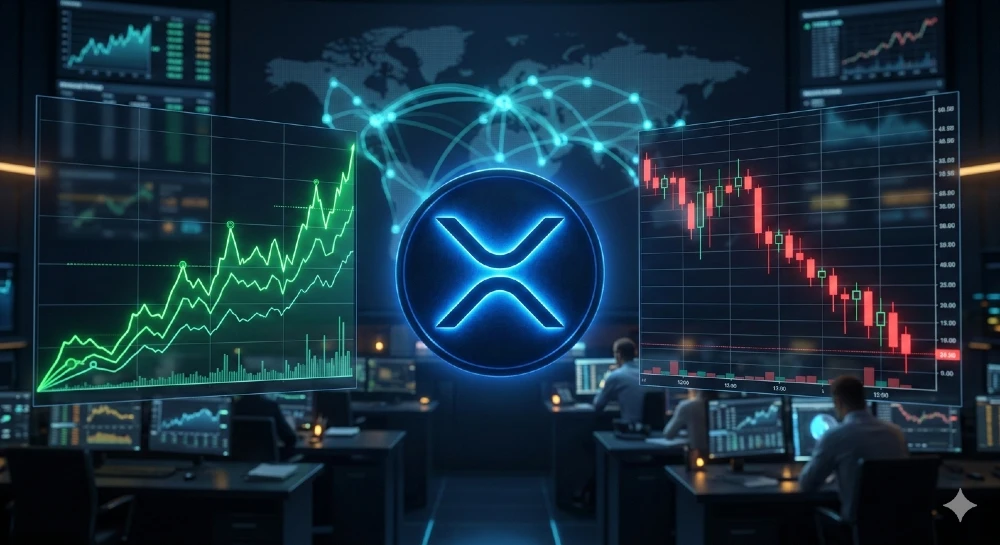
XRP Price Prediction: Activity on XRP Ledger Increases – Traders Are Watching This Tricky Turn
The XRP Ledger is showing more activity while XRP’s price is down nearly 30% year-to-date. That gap between network usage and price is exactly what traders are trying to decode right now — and it’s not as simple as “bullish signal incoming.”
What’s Actually Happening With XRP Right Now
| Signal | Current Status |
|---|---|
| XRP Price (March 2026) | ~$1.35–$1.46 |
| Daily Transactions on XRPL | 2.1M – 2.8M per day |
| Active Addresses (Feb 24, 2026) | 14,551 (down from 32,684 on Feb 10) |
| AMM Deposits | New highs above 14,000 |
| Successful Payments (Feb vs Dec) | Up from 1M to 2.7M |
| RWA Tokenization on XRPL | Surpassed $354 million |
| Exchange Outflows (10-day) | 200 million XRP left Binance |
| Fear & Greed Index | ~24 (Extreme Fear) |
| Key Support | $1.27 – $1.35 |
| Key Resistance | $1.50 – $1.67 |
Bottom line: The network is being used. But price is not following — yet. This is either an early accumulation phase or a slow bleed. Both scenarios are live. This article breaks down what each metric actually means and what you should watch next.
Why Is XRP Ledger Activity Rising While Price Falls?
This is the central contradiction traders are staring at right now. Network activity up. Price down 30% year-to-date. How does that happen?
Here’s the honest answer: network activity and price are not the same thing. They often move together in bull markets but decouple in fear-driven sell-offs.
On the XRPL, successful payments jumped from around 1 million in December 2025 to over 2.7 million in February 2026. AMM (Automated Market Maker) deposits hit new highs above 14,000. Real-world asset tokenization on the ledger crossed $354 million. Daily transaction counts are holding between 2.1 million and 2.8 million. These are not junk numbers. They suggest genuine usage — not just speculation.
But at the same time, active addresses crashed. From a 2026 peak of 32,684 on February 10 down to 14,551 by February 24. That’s a 55% drop in just two weeks.
So which metric do you trust?
Both, but separately. High transaction count with falling active addresses means fewer wallets are doing more work — likely institutional or automated activity, not retail. When large players move quietly, they don’t create thousands of new wallet addresses. They execute large volumes through existing ones.
This is not a bullish confirmation. But it is not a collapse either. It is a transition. And transitions are the hardest part to trade.
What On-Chain Metrics Are Traders Watching on XRPL — And What Each One Means
If you are new to on-chain analysis, here is a practical breakdown of what matters and why. Not all metrics are equal.
Daily Active Addresses (DAA)
This counts how many unique wallet addresses sent or received XRP on a given day. It is a measure of retail or user-level participation.
When DAA is high: more people are using XRP actively, often linked to price rallies or new use cases going live.
When DAA drops sharply (like the 55% drop seen in late February 2026): it typically means retail has stepped back. Either they are waiting on the sidelines, or they exited.
What to watch: If DAA starts rising again while price is still flat, that is an early signal of fresh user interest before price moves. DAA leading price is a classic setup.
Transaction Velocity
Velocity measures how fast XRP is moving between wallets relative to total supply. A spike in velocity means XRP is circulating rapidly — changing hands quickly across the network.
In 2025, CryptoQuant recorded XRPL velocity hitting 0.0324, the highest level of that year. The XRPL also processed over 2.23 billion XRP in payments in a single day during that spike.
High velocity during price consolidation is often a sign of position reshuffling — whales moving coins, institutions rebalancing, or traders rotating. It doesn’t automatically point up or down, but it does confirm that large players are active.
Exchange Inflows vs. Outflows
This is simple but powerful. When large amounts of XRP move to exchanges like Binance, it usually means sellers are preparing to dump. When XRP leaves exchanges, it often means holders are moving coins to personal wallets — reducing sell pressure.
Recent data shows 200 million XRP left Binance over just 10 days. That is a meaningful supply withdrawal from the market. At the same time, over 31 million XRP was transferred to Binance in a single day in one spike — linked to whale wallets, likely preparing to sell.
Both things happened in the same week. This is why exchange flow analysis requires context, not just headlines.
The rule: Watch direction AND wallet size. Small wallets sending to exchanges = panic selling. Large wallets (10M+ XRP) withdrawing from exchanges = quiet accumulation.
Funding Rates
Funding rates are fees paid between long and short traders in perpetual futures markets. When funding drops negative, it means more traders are betting on a price drop (short). Historically, extreme negative funding has preceded price rebounds — not because bears are wrong, but because short positions eventually get squeezed.
Binance funding rates for XRP dropped to -0.028% in late February 2026, the lowest since April 2025. That is a contrarian bullish indicator. It means the market is heavily pessimistic — and extreme pessimism often marks bottoms, not continuations.
The Tricky Technical Turn Traders Are Watching
Here’s where it gets genuinely uncertain. And you should not let anyone simplify it for you.
XRP’s price chart in early 2026 is showing what some analysts call a cup-and-handle pattern forming near the $1.20–$1.50 range. This is a classic bullish continuation pattern — but it only triggers on a confirmed breakout with volume. Without that, the “cup” just becomes a slow slide.
Key levels you need to know:
- $1.27: Critical weekly support. If XRP closes a full weekly candle below this level, it opens downside toward the $1.00 psychological zone and potentially lower.
- $1.35: Current floor and near-term support. Price is hovering here right now.
- $1.50: First resistance. This has rejected price multiple times. A break above it with volume changes the short-term picture.
- $1.67–$1.70: Stronger resistance zone. Breaking through here on high volume would signal a real trend shift.
- $1.80: Next meaningful ceiling if $1.67 breaks convincingly.
The RSI (Relative Strength Index) on the daily chart sits around 32–34. That is approaching oversold territory. RSI below 30 has historically preceded bounces for XRP, but it is not a guaranteed reversal signal — it can stay oversold for weeks.
MACD is registering slightly in buy territory (-0.15), but moving averages are still overwhelmingly bearish. Daily price remains below both the 50-period and 200-period EMAs (Exponential Moving Averages). That means the trend is still technically down until proven otherwise.
What this means practically:
If you are a trader watching this setup, the logical plan is:
- Wait for a confirmed close above $1.50 on the daily candle before making any bullish move
- Watch volume — a move on low volume is a trap, not a trend
- Keep $1.27 as your hard line — if it breaks on a weekly close, the setup is invalid
Do NOT chase green candles in a still-bearish structure. XRP has faked reversals before.
Why the XRP Ledger Activity Spike Matters — Even If Price Isn’t Responding Yet
The gap between on-chain growth and price movement is worth examining closely, because it contains a real signal.
The XRPL processed 1.8 million daily transactions in Q3 2025, a 9% quarter-on-quarter increase. Active addresses surged 142% that quarter, and new account creation rose 12%. These are not small numbers. They reflect a network growing in real use.
Real-world asset (RWA) tokenization on XRPL crossed $354 million. Ripple partnered with Aviva Investors to tokenize fund structures. Japan’s SBI Holdings is issuing blockchain-based bonds with XRP-linked rewards. Ripple and Guggenheim are investing $10 million to accelerate RWA tokenization on XRPL.
That is institutional infrastructure being built — not speculated, actually built.
Here is why this matters for price but on a delay:
Institutional adoption doesn’t show up in price the same day a deal is announced. It shows up when the infrastructure goes live, when volume starts flowing through it, and when that volume creates real demand for XRP as a settlement asset. That process takes quarters, sometimes years.
So the activity you are seeing now is laying a foundation. But trading it today as if the foundation is already a skyscraper is how people get caught.
The honest take: if XRPL usage metrics continue growing for two to three more quarters consistently, XRP’s price floor gets higher and higher. If they plateau or drop, the bull case weakens significantly.
What Is the XRPL AMM and Why Are New Highs There Significant?
Quick explanation because this keeps coming up and most articles skip it.
An AMM (Automated Market Maker) on the XRP Ledger is a smart liquidity pool. Instead of using a traditional order book where buyers and sellers match manually, an AMM holds two assets (like XRP and USDC) and automatically prices trades based on the ratio between them.
When you add funds to an AMM pool, you become a liquidity provider. You earn a share of trading fees every time someone swaps through that pool.
AMM deposits on XRPL hitting new highs above 14,000 means more capital is being locked into these pools. That is meaningful for two reasons:
- It shows growing DeFi activity on XRPL — the network is not just for payments anymore
- Locked liquidity generally reduces the circulating supply available for trading, which is mild positive pressure on price
But here is what to watch: If AMM deposits spike but trading volume through those pools drops, it could mean liquidity is being added speculatively — people chasing fees — rather than genuinely serving demand. Always check pool utilization, not just deposit numbers.
What Could Push XRP Price Back Up — And What Could Keep It Down
No guarantees here. But these are the actual variables that matter.
Catalysts that could drive XRP higher:
- Spot ETF performance: XRP ETF products have pulled in over $874 million in net inflows. If inflows accelerate, exchange supply gets further squeezed.
- XRPL 3.0 upgrades: Ripple has planned zero-knowledge proof-based privacy tools and native lending features for XRPL. If these launch on schedule, it brings new institutional-grade use cases.
- ODL volume growth: On-Demand Liquidity (ODL) is Ripple’s payment corridor product where financial institutions use XRP to move money cross-border in real time. If a major sovereign bank or remittance corridor announces ODL adoption, that is a strong catalyst.
- Bitcoin-led cycle: XRP rarely moves independently of broader market sentiment. If Bitcoin reclaims key levels and risk-on sentiment returns, XRP typically follows with higher percentage moves.
- SBI Holdings and Japan: Regional institutional demand from Japan has been a consistent XRP driver. More activity here is a watch point.
Risks that could push XRP lower:
- Whale dump risk: Over 31 million XRP moved to Binance in a single day. Large holders exiting at scale can overwhelm any technical support level.
- Catalyst exhaustion: Now that the SEC lawsuit is fully resolved, XRP no longer has a “when the lawsuit ends” catalyst to run on. The market needs new fundamental fuel.
- Escrow unlocks: Ripple releases locked XRP from escrow on a scheduled basis. Traders watch these releases closely — even the perception of new supply hitting the market can create sell pressure in weak conditions.
- Stablecoin competition: Ripple’s own RLUSD stablecoin competes with XRP for cross-border payment use cases. The more RLUSD gets adopted, the more the question becomes: does that replace XRP’s role or complement it?
- SOPR below 1.0: Santiment data showed XRP recording its largest on-chain realized loss spike since 2022. When SOPR (Spent Output Profit Ratio) drops below 1.0, it means coins are moving at a loss — sellers are capitulating. This can mark bottoms but also signals ongoing distribution from those who bought higher.
XRP Price Prediction: What Are Realistic Ranges to Watch?
These are structured scenarios — not promises, not financial advice. Treat them as “if X happens, then Y becomes likely” frameworks.
Short-term (Next 30–60 days):
- Bearish scenario: XRP loses $1.27 weekly support → possible drop toward $1.00–$1.10 range. Whale inflows to exchanges and continued retail exit would confirm this path.
- Base scenario: XRP stays range-bound between $1.27 and $1.50, accumulation continues quietly, no major breakout yet. This is the most likely outcome given current mixed signals.
- Bullish scenario: XRP breaks and closes above $1.50 with rising volume → next target $1.67–$1.80. Requires either a market-wide sentiment shift or a concrete XRPL adoption announcement.
Medium-term (Rest of 2026):
- If XRPL transaction growth continues and new institutional deployments go live, analysts from Standard Chartered see $5–$8.50 as achievable. That requires genuine catalyst momentum, not just technical positioning.
- A range of $2.50–$3.20 represents the consensus from most analyst platforms if adoption stays on its current trajectory without major new catalysts.
- A break below $1.00 would represent a significant psychological breakdown and would likely require a broader crypto market collapse or unexpected negative regulatory event.
What you should NOT do: Chase a pump from $1.35 to $1.60 thinking $5 is right around the corner. The path from current levels to higher targets requires specific conditions — sustained on-chain growth, volume-backed breakouts, and macro tailwinds. None of those are confirmed yet.
The Real Risk Nobody Talks About With XRP
Here it is plainly: XRP’s market cap is still largely driven by narrative and speculation, not verified utility at scale.
Coin Metrics data points to a significant gap between XRP’s valuation and the transaction fees generated on XRPL. Total fees collected remain minimal relative to the asset’s total market cap. That means the price is still being held up by expectations of future adoption — not by current, measurable economic flow through the network.
This isn’t unique to XRP. Most crypto assets have this gap. But XRP specifically is trading on the expectation that payment corridors, tokenization, and DeFi on XRPL will grow into its valuation. If that growth stalls, the price corrects to reflect actual utility — and that correction could be significant.
The smart position is this: Follow the on-chain metrics quarterly, not daily. If XRPL transaction volume, active addresses, and ODL utilization grow consistently over three to four quarters — the bull case strengthens and the network is proving itself. If those metrics plateau while price pumps — that is a warning sign, not a breakout signal.
How to Track XRP Ledger Activity Yourself (Without Relying on Secondhand Analysis)
You don’t need to take anyone’s word for it. Here is exactly where to verify the data yourself:
- XRPScan (xrpscan.com): The leading XRP Ledger block explorer. Check daily active addresses, transaction counts, AMM pools, and validator data directly. Free and real-time.
- CryptoQuant: On-chain analytics including exchange flows, velocity, and funding rates. Some features are free, deeper data requires a subscription.
- Messari: Publishes quarterly “State of XRP Ledger” reports with standardized metrics. Good for quarter-over-quarter comparison.
- Santiment: Tracks social sentiment, SOPR, and realized profit/loss data. Useful for understanding when retail and whales are moving.
Step-by-step: How to check XRP health on XRPScan
- Go to xrpscan.com
- Click “Metrics” in the top navigation
- Look at “Daily Active Addresses” and “Transactions Per Day”
- Compare today’s number against the trailing 30-day trend
- If both are rising steadily: network health is improving
- If addresses fall while transactions hold: large players active, retail quiet
- If both fall simultaneously: genuine slowdown, reassess the bull case
This takes less than five minutes. And it gives you more signal than most price prediction articles.
Blockchain tracing and legal recovery pathways for hacked funds. Prevent future theft with secure Solana wallet practices.
Final Thought: What This “Tricky Turn” Actually Means for Traders
The phrase “tricky turn” is accurate. XRP is not clearly bullish or bearish right now. It’s caught between genuine network growth and a price structure that’s still technically in a downtrend.
The honest assessment:
- Network activity is real and growing in some areas
- Price is down, retail is quiet, and the trend is still bearish on higher timeframes
- Institutional infrastructure is being built — but the payoff from that is quarters away, not days
- The setup for a reversal exists — but reversal needs confirmation, not assumption
If you are holding XRP long-term, the XRPL fundamentals give you a reason to stay patient. If you are trading short-term, do not fight the trend without confirmation. Wait for $1.50 to break with volume, or watch $1.27 for the next signal.
Either way, the smartest move right now is to track the ledger data yourself, ignore the noise, and let price action confirm what the on-chain metrics are suggesting.
The network is saying something. Price just hasn’t responded yet. Whether that’s a delay or a divergence is the question 2026 will answer.
This article is for educational purposes only. It is not financial advice. Cryptocurrency markets are highly volatile. Never invest more than you can afford to lose, and always do your own research before making any investment decisions.

Financial Analyst Iqra Zahoor provides data-driven crypto analysis & strategies. Guiding you from market trends to informed investment decisions.
![How to Build a Crypto Risk Management Checklist for Beginners [2025]](https://thedawncrypto.com/wp-content/uploads/2026/03/Crypto-Risk-Management-Checklist-for-Beginners-660x470.webp)