What Role Do Institutional Investors Play in Bitcoin Sell-Offs?
When Bitcoin drops 10% in two days with no obvious news trigger, institutional investors are usually behind it — not retail panic. The real question isn’t whether they’re selling. It’s how they do it, why they do it when they do, and what it actually means for Bitcoin’s price. This article breaks down the full mechanics, from OTC desks to ETF redemption cycles to liquidation cascades — so you understand what’s actually happening when the market bleeds.
Institutional investors drive Bitcoin sell-offs through three main channels: ETF redemptions handled by authorized participants, OTC block trades executed quietly off-exchange, and derivatives unwinds that amplify spot selling by 3–5x. They don’t dump on exchanges like retail traders. They use infrastructure designed to move hundreds of millions without telegraphing the move — until the price impact hits 24–48 hours later.
How Do Institutions Sell Millions in Bitcoin Without Crashing the Market Immediately?
Most people imagine a hedge fund selling Bitcoin the same way a retail trader does — logging into an exchange and hitting “sell.” That’s not how it works at all.
When a fund needs to exit $200M in BTC, doing it on a public exchange like Coinbase or Binance would destroy the order book. The bid depth on most exchanges can’t absorb that without slipping 5–10% on price. So institutions use a completely different infrastructure.
OTC (Over-the-Counter) desks are private trading floors — operated by firms like Coinbase Prime, Cumberland, and Genesis Trading — where large Bitcoin blocks get matched between buyers and sellers without touching the public order book. Here’s how it works step by step:
- The institution contacts an OTC desk with a sell order (e.g., “I need to exit 3,000 BTC over 48 hours”)
- The desk finds a counterparty — another institution, a market maker, or a liquidity provider
- The trade settles privately, usually at a price close to spot but negotiated
- The buyer handles their own hedging separately
This is why you often see Bitcoin’s price hold steady for hours after a major institutional decision — the selling is happening invisibly. The price impact shows up later when the OTC desk’s counterparty hedges their own position on-market.
TWAP algorithms (Time-Weighted Average Price) are another tool. Instead of selling 3,000 BTC at once, the algorithm breaks it into hundreds of small orders spread across hours or days, blending into normal volume. You’d never know a single entity placed those orders.
What not to do if you’re tracking institutional exits: Don’t just watch exchange order books. By the time the selling shows up there, you’re already late. Watch OTC flow reports from Coinbase Prime, on-chain wallet movement from large custodial addresses, and CME futures open interest instead.
What Is the ETF Redemption Machine and How Does It Create Selling Pressure?
Bitcoin ETFs — BlackRock’s IBIT, Fidelity’s FBTC, and others — work differently from just “buying Bitcoin.” Understanding the redemption mechanism explains a lot of the sell-off patterns people can’t figure out.
When an investor sells their ETF shares, those shares don’t just disappear. An authorized participant (AP) — firms like Jane Street, Virtu Financial, or Citadel Securities — steps in to balance supply. Here’s the actual cycle:
- A large investor redeems 50,000 IBIT shares worth roughly $250M
- Jane Street (as AP) delivers those shares to BlackRock
- BlackRock transfers the equivalent Bitcoin from Coinbase Prime custody back to Jane Street
- Jane Street now holds real Bitcoin they didn’t want — their job is arbitrage, not HODLing
- They sell that Bitcoin, typically via OTC desks, within 24–48 hours
That final step — step 5 — is the actual market pressure. And it happens every single time there are net outflows from any Bitcoin ETF.
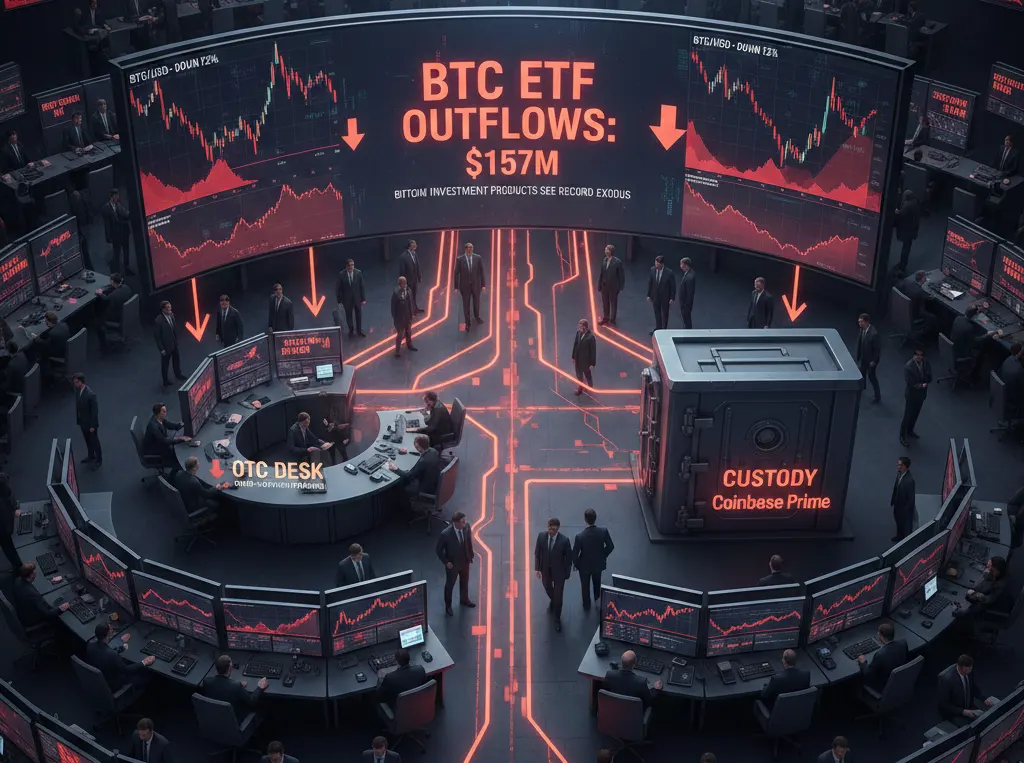
On February 14, 2026, IBIT saw approximately $157M in outflows. That required APs to liquidate roughly 1,650 BTC into the market. One redemption event. Nearly 1,700 Bitcoin hitting sell-side channels. Multiply this across FBTC, ARK21Shares, and Bitwise on the same week, and you understand why $500M in ETF outflows can translate into a price drop that looks disproportionately large.
The key point most people miss: ETF outflows don’t mean “investors are scared of Bitcoin.” Sometimes it’s pure portfolio rebalancing — a pension fund trimming its allocation to stay within a 2% limit after BTC ran up 30%. The selling is mechanical, not emotional.
Understanding why crypto markets decline requires examining macro triggers. Government regulations on Bitcoin market declines often force institutional hands, creating forced selling scenarios. Regulatory uncertainty compounds liquidity crunches, pushing large holders toward exit strategies that amplify downward volatility beyond typical market corrections.
Why Does Bitcoin’s Price Drop 48 Hours After ETF Outflows — Not Immediately?
This timing confuses a lot of people. They see ETF outflow numbers reported on Monday, but the price doesn’t move until Wednesday. Why?
Settlement cycles are the main reason. ETF share redemptions settle on T+1 (trade date plus one business day). The actual Bitcoin transfer from BlackRock’s custody to the AP happens after that. Then the AP executes their hedging or liquidation strategy, which itself takes time to minimize their own slippage.
Add in the fact that APs often use TWAP algorithms to exit their newly acquired BTC, and you’re looking at a 36–72 hour lag from the moment outflows are reported to when full selling pressure lands on the market.
Weekend liquidity gaps make this worse. If large outflows happen Thursday, settlement falls Friday. APs then face thin weekend markets to execute. Some wait until Monday’s market open — meaning Friday’s outflow data causes Monday’s price drop.
Practical tip: If you see heavy ETF outflow data on SoSoValue or Bloomberg’s ETF flow tracker on a Thursday or Friday, expect price pressure early the following week, not immediately.
The mechanics of large-scale exits differ fundamentally from individual trader behavior. Bitcoin crash strategies and liquidity risks become critical when institutions unwind positions. Thin order books during off-peak hours can turn modest sales into major price dislocations, triggering automated stop-losses and further accelerating declines across interconnected markets.
Are Hedge Funds or Corporations Driving Bitcoin Sell-Offs? They Behave Very Differently
Not all institutional sellers are the same. Lumping them together is where most analysis goes wrong.
Hedge funds — particularly quant funds running basis trades or risk-parity strategies — are the most aggressive sellers. They don’t hold Bitcoin because they believe in it. They hold it because it fits a spread trade or volatility model. When that model signals risk-off, they exit fast. A fund running a cash-and-carry arbitrage (long Bitcoin spot, short Bitcoin futures) will unwind both legs simultaneously when futures premiums compress — creating double selling pressure on spot price.
Corporate treasuries like MicroStrategy are the opposite. Michael Saylor’s model is explicit: use convertible bonds to buy Bitcoin, hold indefinitely, never sell regardless of price. Their selling pressure is nearly zero. In fact, during ETF outflow periods in 2025, MicroStrategy continued buying — not because they’re reckless, but because their model doesn’t respond to short-term price signals.
Family offices have a different trigger: tax-loss harvesting. If Bitcoin dropped 30% during a year, high-net-worth clients instruct their family office managers to realize the loss before December 31 for tax purposes, then potentially re-enter. This creates predictable selling patterns in Q4, particularly November and December.
The practical implication: When you’re trying to understand a sell-off, the first question is who is selling. Hedge fund unwinding = fast, sharp drop, likely recovery as they re-enter. Corporate treasury selling = almost never. Tax-loss harvesting = seasonal, predictable, temporary.
The mechanics of large-scale exits differ fundamentally from individual trader behavior. Bitcoin crash strategies and liquidity risks become critical when institutions unwind positions. Thin order books during off-peak hours can turn modest sales into major price dislocations, triggering automated stop-losses and further accelerating declines across interconnected markets.
How Does a $100M ETF Outflow Trigger a $1B Bitcoin Price Drop? The Cascade Effect
This is where things get interesting — and where most crypto media completely fails to explain what’s actually happening.
The multiplier effect works like this:
Step 1: $100M in ETF outflows force APs to sell ~1,050 BTC on the spot market.
Step 2: That spot selling erodes order book depth. Bitcoin’s order book on major exchanges is thinner than most people realize — often only $20–30M of bids within 1% of spot price.
Step 3: As spot price dips, Bitcoin perpetual futures funding rates shift negative. Traders holding leveraged long positions face increasing funding costs.
Step 4: Some leveraged longs get liquidated automatically by the exchange (Binance, ByBit, OKX liquidate positions when margin is insufficient). These liquidations are forced market sells.
Step 5: More spot selling → more liquidations → lower price → more liquidations. This is the cascade.
A $100M spot sell can realistically trigger $400–600M in derivatives liquidations through this chain. The original ETF outflow isn’t causing a $1B crash directly — but it starts a chain reaction in a market full of leveraged positions.
What this means practically: Bitcoin’s crash speed depends heavily on how much leverage is sitting in the system at the time. Check funding rates and open interest on Coinglass before making any large Bitcoin position decision. High open interest + elevated funding rates = coiled spring waiting for a catalyst.
Market sentiment shifts rapidly when whale wallets move coins to exchanges. Daily crypto tanking analysis helps track these institutional flows in real-time. Monitoring exchange inflows provides early warning signals before major sell-offs materialize, allowing observers to distinguish between routine rebalancing and genuine panic-driven liquidations.
What Is the Bitcoin Basis Trade and Why Does Its Unwind Double the Selling Pressure?
The basis trade is one of the most important — and least explained — sources of institutional selling pressure.
Here’s how it works in simple terms:
A hedge fund buys $50M of Bitcoin spot (or through an ETF). Simultaneously, they short $50M of Bitcoin futures on CME. The trade profits from the difference (the “basis”) between spot price and futures price — typically 5–15% annualized during bull markets when futures trade at a premium to spot.
It’s market-neutral. They don’t care if Bitcoin goes up or down. They just collect the premium as futures converge to spot at expiration.
The problem: When that premium collapses (futures stop trading above spot), the trade stops working. The fund unwinds. They sell their spot Bitcoin AND cover their short futures position. Two transactions. Both creating market pressure in the same direction — down on spot, buying pressure on futures (which actually pushes futures price up relative to spot, compressing the basis further and forcing more unwinds).
This is a self-reinforcing feedback loop. And it’s why some sell-offs accelerate in ways that seem irrational — it’s not fear, it’s mechanics.
CME Bitcoin futures open interest dropping sharply alongside spot price decline is often the tell that basis trade unwinding is happening.
Interest rate environments heavily influence institutional crypto allocation decisions. How interest rate hikes impact Bitcoin prices explains why rising yields make risk assets less attractive. When treasuries offer competitive returns, Bitcoin’s volatility premium becomes harder to justify, prompting systematic reductions in institutional portfolios and contributing to broader market weakness
Can You Track Institutional Selling Before the Price Drops? The 72-Hour Warning System
You won’t always catch it, but there are signals worth monitoring. None of these are perfect individually — use them together.
ETF flow data: SoSoValue (free) and Bloomberg Terminal (institutional) show daily inflows and outflows per ETF. Three or more consecutive days of outflows exceeding $100M combined across all spot Bitcoin ETFs is a yellow flag.
CME futures open interest: Rising open interest during a price decline means new shorts are being added — bearish. Falling open interest during decline means longs are closing — less bearish, more likely to stabilize.
Funding rates on perpetual futures: Check Coinglass. Funding rates going sharply negative means shorts are paying longs — historically associated with capitulation and approaching bottoms. Mildly negative funding during a slide means selling still has room to run.
On-chain exchange inflows: Large amounts of Bitcoin moving from cold storage or custody wallets to exchange deposit addresses is a pre-sell signal. Blockchain explorers like Glassnode or CryptoQuant track this.
The 48-hour rule: If you see heavy ETF outflows reported Tuesday, don’t expect immediate price impact. Thursday or Friday is when the AP selling typically hits the market fully.
What not to do: Don’t treat any single signal as definitive. Chasing signals in real-time without understanding the lag effect causes more losses than it prevents. Use these to build context, not as trading triggers.
Interest rate environments heavily influence institutional crypto allocation decisions. How interest rate hikes impact Bitcoin prices explains why rising yields make risk assets less attractive. When treasuries offer competitive returns, Bitcoin’s volatility premium becomes harder to justify, prompting systematic reductions in institutional portfolios and contributing to broader market weakness
When Does Institutional Selling Signal a Bitcoin Bottom vs. Further Collapse?
This is the question everyone actually wants answered. And there’s a real, practical distinction.
Forced selling (margin calls, fund redemptions, liquidation cascades) looks different from strategic rebalancing (planned portfolio adjustments, tax harvesting, risk-off rotation). Recovery timelines are completely different.
Forced selling characteristics:
- Volume spikes sharply (3–5x average daily volume)
- Price drops fast — 10%+ in under 24 hours
- Funding rates go deeply negative (–0.05% or lower on Binance)
- Exchange inflows spike on-chain
- After capitulation, Bitcoin tends to stabilize within 48–96 hours as forced sellers are exhausted
Strategic rebalancing characteristics:
- Volume is elevated but steady — not spiking
- Price decline is gradual, grinding
- Funding rates stay mildly negative or neutral
- No dramatic spike in exchange inflows
- Recovery is slower and less predictable
The 2022 FTX collapse was forced selling at an extreme — permanent loss of capital, contagion across multiple entities, no quick reversal. The 2025 ETF outflow periods were strategic rebalancing — reversible, institutional, no underlying damage to Bitcoin’s network or custody infrastructure. Same percentage price drops, completely different causes, completely different recovery speeds.
Why Is Institutional Selling Actually a Sign of Bitcoin’s Maturation?
Counterintuitive point worth sitting with: the fact that institutions can sell billions of dollars of Bitcoin is itself bullish for the long term.
A market where only buyers exist isn’t a market — it’s a one-way bet. The existence of large, sophisticated sellers means two-way price discovery is working. It means Bitcoin has enough liquidity depth that $500M can exit without destroying the asset. That didn’t exist in 2017. It barely existed in 2021. It exists now.
ETF outflows also mean something specific: the capital came in through ETFs first. Institutions bought. Now some are rebalancing. That’s normal portfolio management, not rejection of Bitcoin as an asset. Rotation out of IBIT into cash is different from “institutions don’t believe in Bitcoin.”
On-chain data consistently shows that during ETF outflow periods, long-term holder (LTH) wallet balances increase. Glassnode data from Q1 2026 showed LTH supply rising even as ETF outflows hit $2B+ over 30 days. The coins are moving from short-term institutional holders to long-term conviction holders. Some call this “weak hands to strong hands” — a more durable ownership base.
Frequently Asked Questions
Do institutional investors cause every Bitcoin crash? Not every crash, but most significant ones in 2024–2026 have had institutional mechanics at their core — either ETF outflows, basis trade unwinds, or CME futures expiry-related hedging. Retail panic usually amplifies rather than starts the move.
How can I tell if Bitcoin’s drop is institutional or retail panic? Look at volume, on-chain exchange inflows, and ETF flow data together. Institutional selling typically shows steady volume over multiple days. Retail panic shows sudden volume spikes with heavy social media activity.
Is it illegal for institutions to coordinate Bitcoin selling? Coordinated selling to manipulate prices would be illegal. But independent decisions by multiple institutions to reduce risk simultaneously — even if it looks coordinated — is legal. Bitcoin markets have far less regulatory protection against this than stock markets.
Do Bitcoin ETF outflows always cause price drops? Not always, but sustained outflows over multiple days without offsetting inflows typically do create downward pressure through the AP liquidation mechanism described above.
What tools track institutional Bitcoin flows in real time? SoSoValue for ETF flows (free), Coinglass for derivatives data (free), Glassnode and CryptoQuant for on-chain data (paid plans for deep data), and CME Group’s own reports for futures positioning.
Final thought: The next time Bitcoin drops 8% and financial media blames “market fear” or “macro uncertainty” — go check ETF outflow data on SoSoValue first. Ninety percent of the time, you’ll find the actual answer sitting in a redemption basket being unwound by Jane Street or Virtu. It’s not mysterious. It’s just infrastructure most people don’t know exists.