How Do Crypto Liquidations Trigger Bitcoin Price Drop?
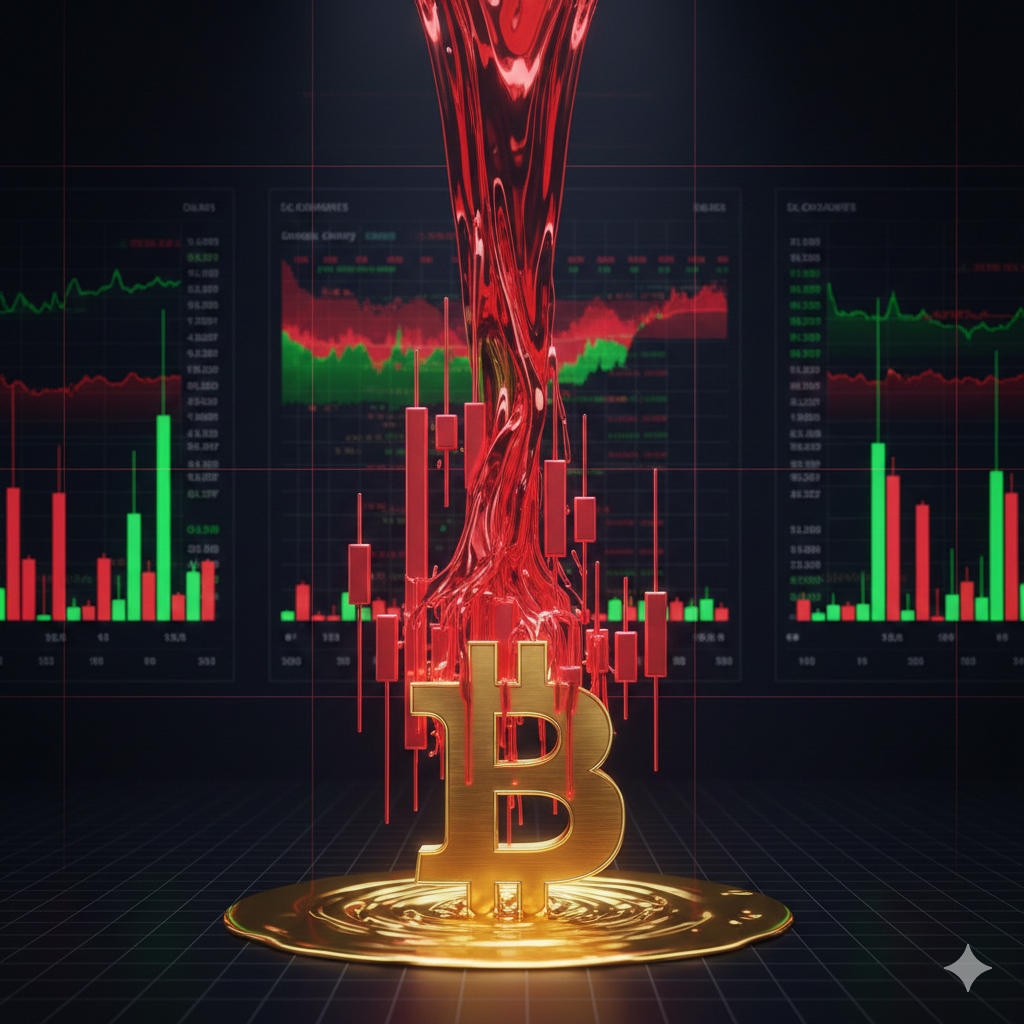
When Bitcoin suddenly drops 10%, 15%, or even 30% in a matter of hours, most people blame “market panic” or “whale selling.” But the real engine behind those violent crashes is usually something more mechanical — liquidation cascades. Not emotion. Not news alone. A chain reaction built into the derivatives market that, once started, feeds itself until the fuel runs out.
This guide breaks down exactly how that mechanism works, who’s involved, how to spot it coming, and what you can do to protect yourself.
What Actually Happens When a Bitcoin Position Gets Liquidated? (The 4-Step Execution Chain)
Before we talk about cascades, you need to understand what a single liquidation actually looks like at the technical level. Most people know it as “losing your position.” What actually happens is more precise than that.
When you trade Bitcoin on a platform like Binance or Bybit using leverage, you’re borrowing capital to control a position larger than your actual deposit. That deposit is called your margin — it’s the collateral holding your trade open.
The exchange doesn’t track your liquidation risk based on the spot price you see on CoinMarketCap. It uses something called the mark price — a weighted average derived from multiple exchanges and the funding rate. This prevents one exchange from having a flash wick that artificially liquidates thousands of traders.
Here’s the 4-step chain when a position hits its limit:
Step 1 — Mark Price Crosses the Liquidation Threshold Your margin ratio (remaining margin ÷ position size) drops below the exchange’s maintenance margin requirement. On Binance, this is typically 0.5% for Bitcoin. On Bybit, it varies by leverage tier.
Step 2 — The Liquidation Engine Activates This is automated software, not a human decision. The exchange’s liquidation engine takes over your position instantly. At 100x leverage, a 1% adverse move against you triggers this. At 10x leverage, it takes a 9% move.
Step 3 — Your Position Becomes a Market Order This is the critical part most people don’t know. Your position doesn’t just “close.” It gets converted into a market sell order (if you were long) and sent into the order book. This happens within 50 to 500 milliseconds — faster than any human can react.
Step 4 — Partial or Full Closure Depending on Insurance Fund If the liquidation order fills at a price better than your bankruptcy price, the surplus goes to the exchange’s insurance fund. If it fills worse — meaning the market moved so fast that even the liquidation order lost money — the exchange uses the insurance fund to cover the gap. If the insurance fund is depleted, Auto-Deleveraging (ADL) kicks in, which we’ll cover later.
The key takeaway: a liquidation isn’t a gentle exit. It’s a forced market sell, executed at whatever price the order book can absorb — instantly.
Why Do Forced Sell Orders Cause Bitcoin Price Drops Instead of Stabilizing It?
This is where most people get confused. In theory, selling should find buyers and stabilize. In practice, during volatile markets, the opposite happens. Here’s why.
Order book depth collapses under stress.
Under normal conditions, Bitcoin’s order book on a major exchange like Binance might have $10 million in buy orders stacked within 0.5% below spot price. During a sell-off, market makers — the firms that provide most of that liquidity — start pulling their quotes. They do this because their risk models detect elevated volatility and they don’t want to absorb losses. Within seconds of a sharp move, that $10 million in buy support can drop to $1–2 million.
Now a forced market sell order for, say, $50 million worth of Bitcoin hits that thinned-out order book. It doesn’t fill at one price. It tears through every available bid, dropping the price several percentage points just from that one liquidation.
The bid-ask spread explodes.
Under normal conditions, Bitcoin’s spread on a major exchange is around $1–5. During a liquidation event, that spread can jump to $50–200 or more. This means every market sell (forced or voluntary) executes at a worse price than expected. The liquidation order that should have closed at $95,000 might actually close at $93,500 — adding another data point that tells other traders “the market is breaking down.”
The liquidity vacuum phenomenon.
When volatility spikes hard, not only do market makers pull quotes — other participants do too. Spot buyers who planned to “buy the dip” often wait, unsure if the bottom is in. This creates a window where there are almost no willing buyers, and the forced sell orders from liquidations have almost nothing to push against. Price free-falls until it reaches a level where natural buyers step back in.
While liquidation cascades often trigger sudden Bitcoin crashes, understanding the broader liquidity risk landscape helps traders prepare for multiple scenarios. Our comprehensive analysis of Bitcoin crash strategies and liquidity risk factors reveals how forced selling interacts with market depth during extreme volatility events. This guide complements liquidation mechanics by showing how to position size when cascade risks are elevated.
How Does the Liquidation Cascade Feedback Loop Actually Work?
This is the core mechanism. Once you understand this loop, Bitcoin’s violent drops will never surprise you again.
Here’s the feedback loop, step by step:
Price drops → Liquidation threshold breached → Forced market sell → Order book absorbs poorly → Price drops further → Next liquidation cluster triggered → Repeat
Let’s put numbers to this.
Say Bitcoin is at $100,000. A trader with 100x leverage goes long. Their liquidation price is at $99,010 — just a 1% drop away. Hundreds of other traders have similar positions clustered in the $98,000–$99,000 range.
Bitcoin drops to $99,000 due to some news event. Liquidation engine fires. A $30 million forced sell hits a thin order book. Price drops to $97,500. This now triggers the next cluster of long positions — those using 20x leverage who opened near $105,000, with liquidation prices around $98,000. Their liquidations fire. Another $50 million in forced sells hits the book. Price drops to $94,000. This fires yet another cluster. And so on.
Each wave of liquidations creates the price drop that causes the next wave. It’s self-reinforcing. The cascade doesn’t stop because of panic — it stops when there’s no more overleveraged fuel to burn.
The compressed spring analogy: When open interest (total value of all open leveraged positions) builds up over weeks without a major correction, you get a compressed spring. The longer it builds, the more violent the release when something triggers it.
In October 2025, Bitcoin saw $19 billion in liquidations within a 40-minute window. The trigger was a surprise tariff announcement. But the scale of the crash wasn’t because of the tariff — it was because of months of leverage buildup that had nowhere to go.
Liquidation cascades represent one of the primary mechanical drivers behind sudden crypto crashes, distinct from fundamental or regulatory triggers. When exploring why crypto markets crash, it’s crucial to distinguish between structural deleveraging events and external shock-driven declines. While tariffs or regulatory news may spark initial selling, liquidation cascades amplify these moves into full-blown crashes through automated forced selling.
What Is the Difference Between a Liquidation Wick and a True Liquidation Cascade?
Not every sharp candle is a cascade. Understanding the difference matters for how you interpret price action.
A liquidation wick is a rapid, sharp price move on one or a few exchanges that recovers quickly — often within minutes. It looks like a spike downward (or upward) with a long tail on the candle. These are usually caused by thin liquidity on a single exchange, a concentrated cluster of stop-loss orders getting triggered, or a temporary market maker withdrawal. Open interest doesn’t collapse significantly. Volume spikes briefly and returns to normal. Price recovers because the trigger was localized.
A true liquidation cascade is different in three ways:
- Open interest collapses — not just dips. A 10–20% drop in OI across multiple exchanges confirms that actual leveraged positions are being force-closed, not just stop-losses triggering.
- Volume sustains — the selling pressure doesn’t vanish after one candle. It continues across multiple candles, sometimes for 30–90 minutes, because each price drop creates new liquidations.
- Cross-exchange confirmation — price drops simultaneously on Binance, Bybit, OKX, and CME. A wick on one exchange that doesn’t show on others is localized. A cascade shows up everywhere.
What to do: Before panicking at a sharp candle, check Coinglass.com for real-time liquidation data. If total liquidations across all exchanges spike to $500M+ in a 15-minute window and OI is falling sharply, you’re watching a true cascade. If it’s $50M and OI is stable, it’s a wick.
The dynamics of liquidation cascades differ significantly between retail leveraged traders and institutional participants. While retail traders face automated liquidations on derivatives exchanges, institutional Bitcoin sell-offs often involve strategic spot market repositioning through ETFs or OTC desks. Understanding this dichotomy explains why post-ETF liquidation events show different volume patterns compared to pre-2024 retail-dominated cascades.
How Can You Predict a Bitcoin Liquidation Cascade Before It Happens? (The Liquidation Risk Scorecard)
No indicator predicts the future. But certain combinations of data create conditions where a cascade becomes highly probable. Think of this as checking the weather, not predicting the exact moment of rain.
Here’s a practical risk scorecard you can use:
Signal 1 — Estimated Leverage Ratio (ELR) above 0.55 ELR measures how much leverage is in the system relative to Bitcoin reserves on exchanges. When ELR climbs above 0.55, the market is significantly overleveraged. Historically, the May 2021 crash preceded an ELR reading that had been elevated for weeks. After the crash, ELR dropped to 0.19 — the leverage had been completely flushed.
Signal 2 — Funding Rate persistently above 0.03% for 72+ hours Funding rates are fees paid between long and short traders every 8 hours on perpetual futures. When funding is persistently positive above 0.03%, it means longs are overwhelmingly dominant and paying shorts to stay open. This is a crowded trade. Crowded trades unwind violently.
Signal 3 — Open Interest rising while price stagnates or drifts sideways If OI climbs 15–20% over two weeks but price barely moves, that’s the compressed spring. Leverage is building without directional conviction. Someone is adding positions, but price isn’t confirming their thesis. When price finally moves against them, the unwinding is disproportionate.
Signal 4 — Exchange inflow spike above 2 standard deviations When large amounts of Bitcoin suddenly move to exchange wallets, it often precedes selling pressure. A spike of more than 2 standard deviations above the 30-day average is a warning. Combine this with high ELR and you have a high-risk setup.
Combined Risk Score:
- 1 signal: Low-moderate risk. Stay aware.
- 2 signals: Moderate risk. Consider reducing leverage exposure.
- 3–4 signals: High risk. This is when cascades historically happen. Either reduce positions significantly or avoid new leveraged longs entirely.
This isn’t a trading signal. It’s a risk management framework. Use it to understand when the environment is fragile, not to predict exact price movements.
Macroeconomic triggers like interest rate decisions often serve as the initial spark for liquidation cascades, even though the cascade itself is a mechanical derivatives market phenomenon. When analyzing how interest rate hikes impact Bitcoin prices, traders must account for the leverage multiplier effect—where a 2% macro-driven drop can cascade into 10%+ declines through forced liquidations. This interplay between fundamental catalysts and technical cascade mechanics defines modern Bitcoin volatility.
What Is the Estimated Leverage Ratio (ELR) and Why Does It Predict Liquidations?
ELR is a metric developed by on-chain analyst Axel Adler Jr. It’s calculated by dividing the total open interest in Bitcoin futures by the amount of Bitcoin held on exchanges.
Simple version: How much borrowed money is betting on Bitcoin, relative to how much actual Bitcoin is available to back it up.
When ELR is low (below 0.3), leverage is conservative. Most positions have room to breathe. A 5–10% price drop won’t cause mass liquidations because positions are well-margined.
When ELR is high (above 0.5), the market is fragile. Even a moderate price drop of 5–8% can trigger enough liquidations to cascade into a 20–30% crash, because positions are too close to their liquidation thresholds.
How to use it: You can track ELR on CryptoQuant.com. Navigate to the Bitcoin derivatives section and look for “Estimated Leverage Ratio.” When you see it trending upward over several weeks and approaching 0.55+, that’s your signal to check the other indicators and reduce risk if they confirm.
What not to do: Don’t use ELR as a timing tool for entries. It tells you the kindling is dry — not when the spark will come.
How Do Funding Rates Signal Impending Liquidation Risk?
Funding rates are one of the most practical real-time indicators available, and most beginners completely ignore them.
Here’s how they work. On perpetual futures exchanges (Binance, Bybit, OKX), there’s no expiration date on contracts. To keep the futures price aligned with spot price, exchanges use a funding mechanism. Every 8 hours, longs pay shorts (or vice versa) a fee based on how far the futures price deviates from spot.
When the funding rate is positive, longs are paying shorts. This means the market is leaning bullish — more people are long than short. When funding is persistently positive at 0.03% or higher every 8 hours for 72+ hours straight, the long side is extremely crowded. Everyone who wants to be long is already long. There’s no one left to buy. The next significant sell creates a scramble for exits.
When funding reverses or spikes negative (shorts paying longs), the dynamic flips — short squeezes become the risk.
How to check it: Go to Coinglass.com → Funding Rate section. You can see funding rates across all major exchanges in real time. Look for sustained elevated rates, not just one spike.
Funding rate arbitrage unwind risk: Some traders run a “funding harvest” strategy — they go long spot Bitcoin while shorting futures to earn the positive funding rate without directional risk. When funding suddenly collapses or reverses, these traders unwind both legs simultaneously. The futures short gets closed (which pushes futures price up briefly) but the spot long gets sold (which pushes spot down). This can accelerate price declines at the worst moment.
Regulatory announcements frequently trigger liquidation cascades by causing sudden price gaps that breach leveraged positions’ margin requirements. Examining government regulations and Bitcoin market declines reveals how policy uncertainty creates the volatility conditions where liquidation cascades thrive. The May 2021 China mining ban exemplifies this—regulatory news sparked the initial drop, but $10 billion in liquidations amplified it into a 50% crash.
Why Does Open Interest Rising While Price Stagnates Create Liquidation Risk?
Open interest (OI) is the total value of all open derivatives positions — longs and shorts combined — across futures and perpetual markets.
When OI rises alongside price, it’s normal and healthy. New money is entering the market with conviction. When OI rises while price goes sideways or barely moves, something different is happening. Traders are adding leveraged positions, but neither bulls nor bears have the upper hand yet.
Think of it like two groups of people pushing on opposite sides of a door. As more people join each side, the door stays in place — but the potential energy builds. When one side suddenly loses people (triggered liquidations, position closures), the door slams violently.
The OI/Market Cap ratio is useful here. Divide the total Bitcoin futures open interest by Bitcoin’s market cap. When this ratio climbs above its 90-day average by 20% or more, the market is overleveraged relative to its own size. This creates fragility.
Practical check: CryptoQuant and Coinglass both display OI data in real time. Compare current OI to the 30-day average. If OI is 25–30% above its average while price has been flat for 2–3 weeks, treat it as a compressed spring and reduce exposure.
How Do Whale Wallet Movements Predict Liquidation Clusters?
On-chain data gives you a 6–12 hour head start that pure derivatives data doesn’t.
When large Bitcoin wallets — those holding 1,000+ BTC — suddenly move coins to exchange deposit addresses, it often signals incoming selling pressure. These aren’t retail traders. These are entities with enough volume that they need to stage their exits. Moving coins to an exchange is step one of that process.
What to watch:
- Exchange inflow spikes: When BTC inflows to major exchanges (Binance, Coinbase, Kraken) jump more than 2 standard deviations above the 30-day average, pay attention.
- Whale clustering near liquidation zones: Tools like Hyblock Capital and Coinglass show where large liquidation clusters are building. When whale inflows spike and those clusters exist at nearby price levels, the probability of a test of those levels rises.
The lag: On-chain data typically leads derivatives activity by 6–12 hours. A whale sending Bitcoin to an exchange today might trigger a market impact tomorrow. This gives you a window to adjust.
What not to do: Don’t assume every exchange inflow spike means a crash. Whales also move coins for OTC trades, collateral purposes, and other reasons. Use it as a confirmation signal, not a standalone trigger.
Where Do Most Bitcoin Liquidations Occur? (Exchange Concentration Risk)
Binance handles approximately 29.3% of global crypto derivatives volume. Bybit is second. OKX is third. Together, these three exchanges account for the majority of Bitcoin perpetual futures liquidations.
This concentration creates its own risk. When one exchange’s liquidation engine fires a large wave, the price impact on that platform affects the mark price calculations on other platforms — because they all reference similar price feeds. A cascade on Binance can trigger liquidations on Bybit within seconds, not because traders there did anything wrong, but because the mark price moved against them based on Binance’s price action.
Post-ETF shift: Since Bitcoin spot ETFs were approved in January 2024, something significant changed. CME (Chicago Mercantile Exchange) futures open interest began competing with and sometimes exceeding Binance’s Bitcoin futures OI. CME is an institutional venue with different margin rules, different traders, and different liquidation mechanics. When institutional positions on CME unwind, the selling pressure hits differently than retail cascades on Binance. It’s more deliberate, larger in individual size, and often correlated with broader macro movements like equity sell-offs or interest rate decisions.
Geographic risk: A significant portion of crypto derivatives trading originates from Asia — specifically Hong Kong, Singapore, and previously mainland China. Regulatory announcements from these regions can trigger mass liquidations not because of price, but because traders rush to close positions before potential access restrictions. This is a non-price-based cascade trigger that pure derivatives analysis won’t capture.
How Do CEX Liquidation Engines Differ from DeFi Liquidation Mechanisms?
These are two fundamentally different systems, and the risks they create are different too.
CEX (Centralized Exchange) Liquidation: On Binance or Bybit, when your position is liquidated, it happens inside the exchange’s system. You can’t audit the liquidation engine’s code. You can’t verify the exact order fill. The exchange’s insurance fund absorbs losses when liquidations execute below bankruptcy price — but the size of that fund and how it’s managed is the exchange’s internal decision. Some exchanges have faced criticism for lack of transparency here. Hyperliquid’s founder publicly criticized traditional CEX liquidation opacity, arguing that traders have no way to verify whether their liquidations were handled fairly.
The positive side: CEX liquidations typically execute faster and with more liquidity available due to concentrated trading volume.
DeFi Liquidation (Protocols like Aave, Compound, MakerDAO): These protocols run on smart contracts — code that anyone can read and verify on the blockchain. When a collateral ratio drops below the minimum (for example, when Bitcoin falls enough that a loan’s collateral is worth less than required), the protocol automatically allows external parties called liquidators to close that position.
Here’s how it works on Aave: A borrower deposits $150,000 worth of Bitcoin as collateral to borrow $100,000 in stablecoins. The protocol requires a minimum collateral ratio of 130%. If Bitcoin’s price drops enough that the collateral is worth $129,000, anyone can call the liquidation function and receive a bonus (typically 5–10%) for doing so. This incentivizes fast action.
The on-chain verifiability is a major advantage. Every liquidation is a publicly recorded transaction. But DeFi liquidations have their own risks — oracle price feed delays and manipulation (covered in a later section) can cause unnecessary or unfair liquidations.
Auto-Deleveraging (ADL): On CEX platforms, when the insurance fund runs dry during extreme events, ADL kicks in. The most profitable traders on the opposite side of the market get their positions partially closed to cover the losses of insolvent positions. You could be making money on a short position during a crash and suddenly find your position reduced — with no recourse. This is a real, underappreciated risk of using high leverage on centralized exchanges.
Why Did Bitcoin ETF Approval Change Liquidation Dynamics?
Before spot Bitcoin ETFs launched in January 2024, the crypto derivatives market was dominated by offshore retail exchanges. Binance set the tone. Funding rates, open interest, and liquidation cascades were primarily a retail phenomenon.
Post-ETF, the picture is more complex.
CME open interest grew dramatically after institutional investors gained approved, regulated exposure through ETFs. These institutions often hedge their ETF exposure using CME futures — a strategy called basis trading. They buy spot Bitcoin (via the ETF) and simultaneously short CME futures to lock in a spread. This is a market-neutral strategy designed to profit from the premium between futures and spot, not from Bitcoin’s price direction.
The risk: When the basis (spread between futures and spot) compresses — meaning futures prices fall toward spot — these trades become unprofitable. Institutions unwind both legs simultaneously. They sell their ETF shares (spot selling pressure) and close their CME shorts (removing downside pressure briefly). The net effect can be significant spot selling at exactly the wrong time — when Bitcoin is already under stress.
This is a new liquidation dynamic that didn’t exist before ETF approval and that most crypto analysis still doesn’t account for.
What changed for retail traders: Institutional involvement hasn’t reduced volatility as many hoped. It’s shifted where the volatility originates. Large liquidation events now sometimes begin at the institutional level (CME basis compression, macro fund deleveraging) and filter down to retail, rather than the other way around.
How Do Perpetual Futures vs. Quarterly Futures Liquidations Differ?
Most retail trading happens on perpetual futures — contracts with no expiration date. They track Bitcoin’s price through the funding rate mechanism. Liquidations on perps are the primary driver of cascades for most of crypto’s history.
Quarterly futures (expiring in March, June, September, December) behave differently. As expiration approaches, something called pinning sometimes occurs — large open interest holders try to keep price near a favorable level for their contracts. At expiration, all positions close. This can create a predictable volatility event as traders roll positions from expiring contracts into the next quarter.
Rollover liquidation risk: When traders roll from an expiring quarterly contract to the next one, they’re closing one position and opening another. If the market is volatile during this window, some traders get liquidated in the gap between closing the old position and establishing the new one. This creates quarterly expiration volatility that’s somewhat predictable — it happens every three months.
For practical purposes: If you’re entering new leveraged positions in the week before a major quarterly expiration (typically the last Friday of the quarter), understand that volatility can be elevated for mechanical reasons, not fundamental ones.
What Is a Long Squeeze vs. Short Squeeze and Which Causes Bigger Drops?
A long squeeze happens when the majority of leveraged positions are long (bullish bets). When price falls, those longs get liquidated. Their forced sells create more selling pressure. Price falls further, triggering more long liquidations. This is the primary mechanism of most major Bitcoin crashes.
A short squeeze is the opposite. When the majority of positions are short (bearish bets) and price rises, shorts get liquidated. Their forced buys (closing a short = buying back the asset) push price higher. This creates rapid, sharp upward moves.
Which is more destructive? Long squeezes, consistently. Here’s why.
Bitcoin historically attracts more bullish speculation than bearish. At any given moment, there are typically 55–65% more long positions than short positions in the derivatives market. This means when price reverses downward, there’s significantly more leveraged fuel to burn through on the long side than the short side.
Short squeezes produce sharp pumps — often 10–20% in hours — but they tend to recover more gradually because the underlying forced buying pressure dissipates quickly. Long squeezes produce deep crashes — 30–50% or more — that take weeks or months to recover from because the leverage flush resets the market’s entire capital base.
The asymmetry matters. Crashes are faster and deeper than pumps for this structural reason. It’s not just sentiment — it’s math.
How Do Flash Crashes Differ from Liquidation Cascades?
A flash crash is a sudden, severe price drop caused by a specific technical or operational event, not by structural leverage buildup. Examples include:
- A “fat finger” error where someone accidentally places a massive sell order
- An exchange system malfunction
- A single large trader market-selling into thin liquidity
Flash crashes are characterized by a V-shaped recovery. Price drops sharply, often within seconds to minutes, then snaps back almost immediately as buyers recognize the mispricing. Volume is intense but brief.
A liquidation cascade has a different profile. The drop is sustained over 20–90 minutes. Volume stays elevated throughout because each new wave of liquidations creates fresh selling. OI declines significantly. Recovery, when it comes, is gradual — not a V-shape, but more of an L or U-shape as the market rebuilds confidence.
Why the distinction matters practically: If you see a flash crash on one exchange and price hasn’t moved on others, it’s likely operational — not a cascade. Wait for cross-exchange confirmation before making major risk decisions. Panic-selling into a flash crash is one of the most common mistakes retail traders make.
What Are “Liquidation Wicks” and Why Do They Recover So Fast?
A liquidation wick is a long downward (or upward) candle tail that appears on the price chart, where price touches an extreme level briefly before recovering quickly. They’re sometimes called “stop hunts” or “wick candles.”
Here’s what actually happens. A concentrated cluster of stop-loss orders and leveraged positions sits just below a key support level. When price approaches, market makers or large traders push price through that level — either intentionally or simply because their own selling has that effect. The clustered stops trigger. Liquidations fire. Forced sells hit the book.
But because these liquidations are concentrated at one price zone rather than distributed across many levels, the selling is intense but brief. Once the cluster is exhausted, there are no more forced sellers. Price snaps back because the underlying demand was always there — it was just temporarily overwhelmed.
Recovery mechanics: Liquidation wicks recover fast because the leverage has been flushed from that specific price zone. After a wick, OI drops slightly, funding rate often resets closer to neutral, and the order book rebuilds. Buyers who had limit orders just below the wick level suddenly find their orders filled, and they hold — because they entered at attractive prices intentionally.
What not to do: Don’t place stop-loss orders at obvious round numbers or just below clear support levels. These are the exact locations where liquidation clusters and wick events concentrate. If you’re using stops, place them at slightly less obvious levels, or use mental stops executed manually.
How Do Cross-Asset Liquidations Spread from Bitcoin to Altcoins?
Bitcoin accounts for approximately 68% of all crypto derivatives liquidations. When Bitcoin cascades, the damage doesn’t stay in Bitcoin.
Here’s the transmission mechanism. Most altcoins are priced in Bitcoin terms in derivatives markets. When BTC falls sharply, ETH/BTC pairs fall, and altcoin/BTC pairs fall. Combined with direct altcoin liquidations against USDT, traders holding leveraged altcoin positions face double pressure: their position loses value in USD terms, AND Bitcoin is also falling, sometimes triggering margin calls across their entire portfolio if they’re using cross-margin.
ETH as transmission mechanism: Ethereum is the most liquid altcoin and the second-most-traded derivatives asset. When Bitcoin cascades, ETH typically follows within minutes. ETH liquidations then accelerate the selling pressure on the rest of the altcoin market. The correlation during stress events is nearly 1.0 — everything moves together.
Altcoin amplification: Smaller altcoins often see leverage ratios 3–5x higher than Bitcoin, relative to their market cap. This means when selling pressure arrives, altcoin crashes are proportionally much larger. A 10% Bitcoin crash regularly produces 20–35% crashes in mid-cap altcoins and 40–60% crashes in small caps.
For risk management: If you hold leveraged positions in both Bitcoin and altcoins during a high-risk environment (elevated ELR, high funding rates), your risk isn’t additive — it’s multiplicative. A cascade can hit multiple positions simultaneously and in a correlated way that makes diversification meaningless in the short term.
How Do Liquidation Bots Amplify Bitcoin Price Drops?
This is the part of the market that most retail traders have no idea about, and understanding it changes how you view price drops.
When a Bitcoin position is about to be liquidated on a DeFi protocol like Aave or Compound, the protocol sends a signal — a pending liquidation opportunity. Dozens, sometimes hundreds, of automated liquidation bots are constantly scanning the blockchain for these opportunities. They compete to be the first to execute the liquidation and claim the bonus.
These bots operate at millisecond speed — they execute within 50–500ms of a liquidation becoming available. No human can compete. The bots use several techniques:
- MEV (Maximal Extractable Value): Bots pay higher gas fees to get their transactions included first in a block, cutting ahead of other liquidators. This is done through services like Flashbots, which allow private transaction ordering.
- Atomic liquidations: Using flash loans (borrowing with no collateral, repaying in the same transaction), bots can liquidate positions worth many times more than their own capital. They borrow, liquidate, collect the bonus, repay — all in one blockchain transaction.
- Race conditions: Multiple bots target the same liquidation simultaneously. The winner takes the bonus. Losers wasted gas fees. This competition creates a front-running dynamic that makes liquidation execution extremely fast and aggressive.
How this amplifies cascades on DeFi: When Bitcoin’s price drops and triggers multiple liquidations across Aave, Compound, and MakerDAO simultaneously, the bots execute all of them within seconds. This floods the market with forced selling across many protocols at once, compressing what might have been a 2–3 minute process into under 30 seconds — making the price drop steeper and faster.
On CEX: The equivalent dynamic exists but is less visible. Trading algorithms watch order book structure and liquidation cluster data in real time. When they detect that price is approaching a major liquidation zone, some algorithms add selling pressure intentionally, knowing that pushing price into the liquidation cluster will create forced selling that further moves price in their favor. This is controversial but not illegal in crypto markets.
Why Do Retail Traders Get Liquidated More Often Than Institutions?
Three structural reasons, not about intelligence or skill.
1. Margin mode choices. Most retail traders use cross-margin by default — meaning their entire account balance acts as collateral for all positions simultaneously. If one position is losing badly, it drains margin from every other position too. A big move against one trade can cascade into losing multiple positions at once. Institutions typically use isolated margin — each position has its own collateral, so a loss in one trade can’t destroy others.
2. Institutional OTC vs. retail CEX flow. Large institutions don’t execute large Bitcoin purchases through exchange order books. They use OTC (over-the-counter) desks that handle large blocks without moving the market. They also get favorable margin terms and early warning of liquidity conditions. Retail traders buy and sell through the same order book that gets hammered during cascades.
3. ETF hedging protection. Post-ETF, institutions holding Bitcoin through regulated vehicles like the iShares Bitcoin Trust (IBIT) can’t be margin-called in the traditional sense. Their ETF position won’t be force-liquidated by an exchange engine. Retail traders using 50x leverage on Bybit have no such protection.
What retail traders should do: Switch every leveraged position to isolated margin. This is the single most important structural change a retail derivatives trader can make. On Binance, you can toggle this in the trading panel before opening a position. On Bybit, it’s available as a margin mode setting. With isolated margin, your worst-case scenario is losing the margin you allocated to that one trade — not your entire account.
How Do Market Makers Profit from Liquidation Cascades?
Market makers are firms that continuously post buy and sell orders on exchanges, providing the liquidity everyone else trades against. During normal conditions, they earn the bid-ask spread — a few cents per Bitcoin, thousands of times per day.
During liquidation cascades, their strategy shifts.
Step 1 — Spread widening. As volatility spikes, market makers widen their spreads dramatically. Instead of earning $2 per BTC, they’re now earning $50–200. Every trade executed during a cascade — including the forced liquidation market orders — fills against their quotes. This is a period of maximum profit per trade.
Step 2 — Pulling and rebuilding liquidity. Experienced market makers pull their best quotes just before cascade execution to avoid being hit with massive adverse positions. They then re-enter lower, providing liquidity at the post-cascade levels where they accumulate large long inventory cheaply.
Step 3 — Buying the liquidation wick. This is the strategic part. Market makers know that liquidation wicks recover quickly (because the forced selling is temporary). They deliberately place large buy orders at the wick’s lowest points, knowing that price will bounce. Their accumulated inventory then benefits from the recovery.
Why this matters for retail traders: Market makers are not your enemy — they provide the liquidity you need to execute trades. But understanding that they actively benefit from volatility means you should never assume that because price dropped sharply, it’s going to keep falling. Sometimes the sharpest drops are the best buying opportunities — because that’s exactly when sophisticated participants are accumulating.
What Role Do Flash Loans Play in DeFi Liquidation Cascades?
Flash loans are one of the most unusual inventions in decentralized finance. They allow you to borrow millions of dollars worth of crypto with absolutely no collateral — as long as you repay the loan within the same blockchain transaction.
This sounds impossible. It works because of how blockchain transactions execute. Everything in a single transaction either succeeds completely or fails completely. If you borrow $10 million via a flash loan, do something with it, and repay $10 million plus a small fee — all within one transaction — it’s valid. If any step fails, the entire transaction is reversed, including the loan. The lender has zero risk.
How flash loans cause liquidation cascades:
A malicious actor (or aggressive arbitrageur — the line is blurry) can use a flash loan to manipulate a protocol’s price oracle. Here’s the sequence:
- Borrow $50 million in stablecoins via flash loan from Aave
- Use those stablecoins to buy a specific altcoin on a DEX, spiking its price
- Use the now-overvalued altcoin as collateral on a lending protocol to borrow against the inflated value
- Withdraw the borrowed funds
- Let the altcoin price fall back (or sell it, crashing the oracle price)
- The borrowing protocol’s collateral is now worth far less — triggering liquidations on everyone else who held similar collateral
- Repay the flash loan
The protocol suffers the losses. Other users get liquidated. The attacker keeps the profit.
Notable real-world examples: The Euler Finance hack in March 2023 exploited flash loan mechanics to steal approximately $197 million before much of it was returned. The Cream Finance attack in 2021 used flash loans across multiple protocols simultaneously.
Mitigation: Well-designed DeFi protocols use time-weighted average prices (TWAPs) instead of spot prices for their oracles, making single-transaction price manipulation much harder. Always check whether a DeFi protocol uses TWAP oracles before depositing collateral. Chainlink price feeds with deviation thresholds offer better protection than single DEX price references.
How Did the October 2025 $19 Billion Liquidation Event Unfold?
October 2025 produced one of the largest single liquidation events in crypto history. Here’s what happened and why the scale was so extreme.
The setup (weeks before): Open interest across all Bitcoin derivatives platforms had been climbing for six consecutive weeks. ELR had risen above 0.58 — well into the high-risk zone. Funding rates were persistently positive at 0.03–0.05% per 8-hour period, signaling heavily crowded longs. The compressed spring had been building.
The trigger: A surprise announcement of new tariffs affecting tech and crypto-related imports created sudden macro uncertainty. This alone wouldn’t have caused a 19-billion-dollar event under normal leverage conditions. But given the fragile setup, it was enough.
The cascade (minute by minute):
- T-0: Bitcoin drops 4% on spot markets as macro traders reduce risk
- T+2 min: First wave of 100x long liquidations fires on Binance. $800M in 90 seconds.
- T+4 min: Price down 7%. Second wave hits — 50x and 25x longs. $2.3B additional.
- T+8 min: Price down 12%. Cross-exchange confirmation — Bybit, OKX, CME all showing cascading liquidations. ETH starts cascading independently.
- T+15 min: $6.9B liquidated. The order books on all major exchanges have been stripped of bids. Price falls in a near-vertical line.
- T+25 min: $12B liquidated. Altcoins averaging -25 to -40%.
- T+40 min: Total liquidations reach $19B. Price stabilizes as the leveraged positions run out of fuel.
The recovery: Because this was a cascade (leverage flush) rather than a fundamental breakdown, price recovered 40% of the drop within 48 hours as new buyers entered and the compression was gone.
The lesson: The tariff announcement was 5%. The crash was because the market had been sitting on 0.58 ELR for weeks.
Why Did the May 2021 Liquidation Cascade Crash Bitcoin 50% in Hours?
May 2021 remains the case study for how a liquidation cascade can interact with fundamental news to produce catastrophic results.
The fundamental trigger: China announced a sweeping crackdown on Bitcoin mining and trading in mid-May 2021. This was a genuine negative event — Bitcoin’s hash rate would eventually drop 50% as miners shut down or relocated. Markets hadn’t priced this.
The leverage setup: In early 2021, Bitcoin had rallied from $10,000 to $64,000 in six months. The derivatives market had ballooned. ELR had been rising steadily. Funding rates were at some of the most extreme positive levels ever recorded — above 0.1% per 8-hour period at peak.
The cascade: Bitcoin fell from $58,000 on May 12 to $30,000 by May 19 — a 48% drop in one week. Total liquidations exceeded $10 billion. ELR collapsed from above 0.55 to 0.19 — every unit of excess leverage had been destroyed.
The recovery: Because the leverage was completely flushed, Bitcoin found a genuine floor. By October 2021, it had recovered to new all-time highs above $68,000. The deleveraging created the foundation for the next rally.
The important nuance: The China news was real. But it alone wouldn’t have caused a 50% crash. The existing leverage amplified what might have been a 15–20% correction into a cascade that fed on itself for days.
How Did January 2026 Japanese Bond Shocks Trigger Crypto Liquidations?
January 2026 introduced a scenario that many in crypto thought couldn’t happen — a liquidation cascade triggered primarily by events in Japanese sovereign bond markets.
The Japanese yen carry trade is a long-standing strategy where investors borrow in yen (at near-zero interest rates), convert to higher-yielding assets like Bitcoin or US equities, and pocket the spread. When Japanese bond yields spiked unexpectedly — threatening the Bank of Japan’s yield curve control policy — yen borrowing costs rose. Institutions running yen carry trades had to unwind rapidly.
Unwinding a yen carry trade means: selling the higher-yielding assets (Bitcoin, stocks) to buy back yen and repay the loans. This created correlated selling across Bitcoin, Nasdaq, and other risk assets simultaneously. Bitcoin’s role as a “safe haven” failed completely in this scenario — it sold off alongside equities, not in opposition to them.
The crypto-specific liquidation mechanism: Institutions using Bitcoin as collateral for other borrowing faced margin calls as Bitcoin’s price fell. To meet those calls, they sold more Bitcoin. This created a non-derivatives liquidation cascade — forced selling driven by margin calls in traditional finance, not just crypto exchanges.
Cross-asset margin calls: Some traders had positions across crypto, equities, and forex simultaneously through prime brokerage accounts. When losses in one asset triggered margin calls, the broker automatically sold whichever assets were most liquid to cover — and Bitcoin was liquid. So Bitcoin got sold to cover losses in other markets.
This is a structural vulnerability that has grown as institutional participation in Bitcoin has increased. Bitcoin’s liquidity makes it a convenient funding source in multi-asset portfolios, meaning it can be sold to cover non-crypto losses.
What Made the March 2025 Short Squeeze Different from Liquidation Cascades?
March 2025 provides a useful contrast to understand how short squeezes work differently.
Bitcoin’s price had been declining for several weeks, and a growing number of traders had established short positions — betting that price would continue falling. Short open interest had climbed to historically elevated levels, and funding rates had turned negative (shorts paying longs), confirming the crowded bearish positioning.
When positive news emerged — a combination of strong ETF inflows and institutional buying announcement — price jumped sharply. Short positions started losing money. The exchange liquidation engines began firing short closures.
The short squeeze mechanics: Closing a short = buying back Bitcoin. Each forced buy order pushed price higher, triggering the next layer of short liquidations, which forced more buying, which pushed price higher again. Approximately $18.99 million in short positions were liquidated in a concentrated window — small by cascade standards, but the directional effect was a 15% price pump within hours.
The key difference from a long squeeze: The recovery after a short squeeze is typically not V-shaped — it’s more like a slow drift. After longs are flushed in a cascade, the market takes time to rebuild confidence and re-enter positions. After shorts are squeezed, new short sellers often re-enter quickly, capping the upside. The asymmetry again: long squeezes create deeper, longer damage than short squeezes create durable rallies.
How Can Traders Avoid Getting Liquidated During Bitcoin Volatility?
Practical steps, not generic advice.
1. Always use isolated margin. Every leveraged position on Binance, Bybit, or OKX should use isolated margin mode. On Binance: in the futures trading interface, toggle the margin mode button near the top of the order panel before opening a trade. This ensures one bad position can only lose its allocated margin — not your whole account.
2. Know your exact liquidation price before entering. Every exchange shows you the liquidation price on your open position screen. Don’t enter a trade without knowing it. If your liquidation price is within a support zone or a major round number, you’re at higher risk of a wick triggering it.
3. Monitor Coinglass liquidation heatmaps. Before entering any trade, check the liquidation heatmap at Coinglass.com → Liquidation Heatmap. This shows where large liquidation clusters are stacked above and below current price. Avoid placing long entries right above a dense liquidation cluster on the downside — price is likely to sweep it.
4. Don’t trade high leverage during elevated ELR periods. When ELR is above 0.5, funding rates are persistently positive, and OI is at 90-day highs, you’re trading in a fragile market. Reduce your normal leverage by 50–75%.
5. Use portfolio heat monitoring. On Bybit, the “Account Health” indicator shows your overall margin ratio. Keep it above 50% at all times during volatile periods. Below 30%, you’re in danger territory.
What not to do:
- Don’t set stop-losses at obvious round numbers ($90,000, $85,000). These are wick targets.
- Don’t add to losing leveraged positions to “average down.” You’re adding fuel to a position that might cascade against you.
- Don’t hold high leverage through major news events — macro announcements, Fed decisions, geopolitical news. These are the most common cascade triggers.
What Is the Safest Leverage Ratio to Prevent Liquidation Cascades from Affecting You?
There’s no universally “safe” leverage in crypto. But there are rational frameworks.
The 1% Rule: Risk no more than 1% of your total account on any single trade. If your account is $10,000, your maximum acceptable loss on one trade is $100. Position your leverage and stop-loss accordingly.
The Kelly Criterion (simplified for crypto): This mathematical formula for position sizing suggests risking a fraction of your account proportional to your edge. In a market with high uncertainty like crypto, applying even a half-Kelly or quarter-Kelly produces leverage ratios rarely above 2–3x for most setups.
Volatility-adjusted leverage: Bitcoin’s 30-day historical volatility ranges from 30% annualized during quiet periods to 90%+ during cascades. When volatility is low, 5x leverage might feel conservative. When volatility spikes above 60% annualized, even 2x leverage means significant liquidation risk from a normal daily swing.
Practical framework:
- Quiet markets (BTC volatility <40%): Maximum 5x leverage if you must use leverage at all
- Normal markets (BTC volatility 40–70%): Maximum 3x
- Elevated risk environment (ELR >0.5 + high funding + high OI): 1x or no leverage. Sit on the sidelines.
High leverage is a tool that requires near-perfect timing to use safely. For most traders, the risk-adjusted return doesn’t justify going above 3–5x even in favorable conditions. The crypto traders with the best long-term track records are rarely the ones using 50x — they’re the ones who stayed in the game by avoiding forced liquidation.
How Do Stop-Loss Orders Fail During Liquidation Cascades?
Stop-losses are supposed to be your safety net. During normal conditions, they work reasonably well. During a liquidation cascade, they can fail in several ways.
Slippage beyond your stop level: A stop-loss order becomes a market order when your trigger price is hit. During a cascade, when your stop at $92,000 triggers, the market might execute at $90,200 — not $92,000. The order book between $92,000 and $90,200 was empty because market makers had already withdrawn and other stop-losses were hitting simultaneously. You got out $1,800 lower per Bitcoin than you planned.
Exchange server overload: During the October 2025 event, multiple exchanges experienced order processing delays of 15–45 seconds. Stop-loss orders that should have executed at $92,000 didn’t process until Bitcoin had already reached $87,000. This isn’t common, but it happens in the most extreme moments — exactly when it matters most.
MEV bot wick hunting: In DeFi protocols, MEV bots scan the mempool (pending transactions) to identify clustered stop-loss and liquidation orders. When a cluster is visible, bots push price briefly through the level to trigger the stops, harvest the benefit, then allow price to recover. Your stop triggered, your position closed, price bounced — and you missed the recovery because your protective order was used against you.
The alternative — guaranteed stops: Some traditional finance brokers offer guaranteed stop-loss orders that execute at exactly your specified price, regardless of slippage, for a slightly higher spread. This doesn’t exist on most crypto CEX platforms, but some CFD providers offering crypto exposure do provide it. Worth knowing if slippage protection is your priority.
The honest truth: There’s no perfect solution. Wider stops reduce slippage risk but increase your maximum loss. No stops means no automatic protection. The best mitigation is using leverage low enough that you can survive a 15–20% adverse move without being wiped out, giving you time to exit manually.
Why Should You Monitor Liquidation Heatmaps Before Entering Bitcoin Trades?
A liquidation heatmap is a visual representation of where leveraged positions would be force-closed at various price levels. Think of it as an X-ray of the market’s skeleton — showing you where the stress fractures are before they appear.
How to use Coinglass heatmap:
- Go to Coinglass.com
- Navigate to “Liquidation Heatmap” in the data section
- The color intensity shows concentration — brighter/darker zones mean more liquidation value is clustered at that price level
- Green zones = long liquidation clusters (below current price). Red zones = short liquidation clusters (above current price).
The magnet effect: Price tends to gravitate toward dense liquidation clusters. This isn’t mystical — it’s mechanical. Large traders and algorithms know where the clusters are. Pushing price into a long liquidation cluster causes forced selling, which moves price in their favor. It’s a predictable pattern.
Practical use before a trade: If you’re considering a long entry at $95,000 and there’s a dense green (long liquidation) cluster at $92,000 directly below, understand that price may sweep through $92,000 before continuing upward. If your stop-loss or liquidation price is at $92,500, it might get hit even if your long-term thesis is correct. Either place your entry lower (below the cluster) or widen your stop to survive the potential sweep.
What not to do: Don’t treat the heatmap as a guaranteed price target. It shows probability zones, not certainties. The market doesn’t always sweep every liquidation cluster — sometimes it bypasses them entirely. Use it as context, not as a trading signal on its own.
How Does Cross-Margin vs. Isolated Margin Affect Cascade Severity?
This affects you personally as a trader, and it affects the market as a whole.
Cross-margin at the individual level: Your entire account balance backs all your positions simultaneously. If you have $10,000 in your account and three open positions, a large loss on one position drains the margin available to the others. If the loss is large enough, all three positions liquidate. This is how retail traders go from “one bad trade” to “account blown.”
Isolated margin at the individual level: Each position has a fixed margin allocation. If you assign $1,000 to a BTC long and $1,000 to an ETH long, those positions can only lose their allocated margin. A cascade in BTC doesn’t automatically destroy your ETH position’s margin. You lose the $1,000, not everything.
At the market level: When the majority of open interest is in cross-margin mode (as it typically is for retail traders), a cascade has a multiplier effect. One asset’s cascade can trigger liquidations in completely unrelated assets because traders’ accounts are interconnected through cross-margin. This is part of why altcoin cascades happen simultaneously with Bitcoin cascades even when the fundamental news is Bitcoin-specific.
How to switch on major exchanges:
- Binance: Futures trading panel → Click the margin mode button (usually shows “Cross”) near the top → Toggle to “Isolated” → Set your margin amount for that specific position
- Bybit: Similar process — position settings panel has a margin mode toggle before order placement
Make this change today if you haven’t already. It’s the most structurally sound risk management decision available to any retail derivatives trader.
What Is Auto-Deleveraging (ADL) and How Does It Prevent Total Losses?
ADL is the last-resort mechanism exchanges use when everything else has failed.
Here’s the chain of events that leads to ADL:
- A position is liquidated
- The liquidation order executes at a price worse than the trader’s bankruptcy price (the point at which their margin is fully gone)
- The exchange’s insurance fund covers the gap between the bankruptcy price and the actual execution price
- If these losses exceed what the insurance fund can cover — ADL activates
How ADL works: The exchange selects profitable traders on the opposite side of the liquidated position and closes a portion of their positions at the bankruptcy price of the liquidated trader. If you’re on the winning side of a cascade (say, you’re short and Bitcoin is crashing), and ADL kicks in, your profitable short position might be partially closed at a price you didn’t choose — without warning, without your consent.
The ranking system: Exchanges use an ADL priority queue based on two factors — profit percentage and leverage used. The most profitable, most leveraged traders get ADL’d first. This means the very best performance during a cascade makes you most vulnerable to having your position arbitrarily reduced.
How to monitor ADL risk: On Binance and Bybit, there’s an ADL indicator on every open position — usually displayed as a series of five lights. The more lights illuminated, the higher your ADL priority. If all five lights are on, you’re at the top of the queue. Consider reducing your position or taking some profit.
What not to do: Don’t assume your winning position is safe during extreme events. ADL is rare but it happens during the most severe cascades — exactly when your short position might be most valuable to you.
How Do Oracle Price Feeds Create Liquidation Risks in DeFi?
This is a risk that almost no beginner in DeFi understands until they’re affected by it.
In DeFi lending protocols like Aave, Compound, and MakerDAO, the system needs to know Bitcoin’s current price to calculate whether your collateral ratio is above the minimum required. It can’t look at Binance directly — it needs a data feed on the blockchain. These price feeds are called oracles.
The two main oracle types:
Chainlink oracles: Chainlink is a decentralized network of data providers that aggregates prices from multiple sources and delivers a weighted average to the blockchain. It has a deviation threshold — price updates only push to the chain when the price moves more than a set percentage (usually 0.5–1%). This means during rapid price moves, Chainlink’s on-chain price can lag the real market price by 5–15 minutes.
DEX-based price feeds (TWAP): Some protocols use the Time-Weighted Average Price from decentralized exchanges like Uniswap. TWAP is resistant to single-block manipulation but can lag significantly during fast-moving markets.
The liquidation risk:
During a cascade, Bitcoin’s spot price on centralized exchanges falls rapidly. The Chainlink oracle on-chain might still show a price from 8–10 minutes ago — say, $97,000 — while the actual market price is at $88,000. From the protocol’s perspective, your collateral is still $97,000 worth of BTC. But when the oracle updates, your collateral suddenly drops to $88,000 — and you might be instantly below the liquidation threshold with no warning or time to add collateral.
Oracle manipulation attacks: During low-liquidity periods, sophisticated attackers can manipulate DEX prices (which some protocols use as oracles) within a single blockchain block — creating a false liquidation trigger. This is especially dangerous for smaller DeFi protocols using less robust price feeds.
What to do: Before depositing collateral on any DeFi protocol, check which oracle provider it uses. Protocols using Chainlink with multiple aggregators and deviation thresholds are safer than those using single DEX price references. Also maintain a higher collateral ratio than the minimum — keep your health factor (on Aave, this is shown in your dashboard) above 1.5 to survive oracle lag during fast cascades.
Why Do Liquidation Cascades Often Mark Bitcoin Price Bottoms?
This sounds counterintuitive. The worst crashes are often the best entry points. Here’s the logic.
The leverage flush resets the market. When a cascade completes, every overleveraged position that was going to fail has already failed. There’s no more forced selling from the derivatives market. The remaining open interest belongs to traders with stronger margin ratios — positions that can withstand further downside. The market is, paradoxically, more stable after a cascade than before it.
ELR drops to historically low levels. After the May 2021 cascade, ELR dropped to 0.19. After the November 2022 FTX collapse cascade, ELR hit similar lows. These ELR bottoms have historically coincided with multi-month Bitcoin price bottoms — because the conditions that caused fragility have been completely cleared.
Smart money accumulation. During forced selling, price moves to levels that wouldn’t be reachable under normal market conditions. Long-term holders (entities that haven’t moved their Bitcoin in 1–2+ years) historically increase their holdings during cascade events, absorbing the forced selling. This is visible on-chain through metrics like “Long-Term Holder Supply” which typically rises during and after major cascades.
The capitulation flush pattern: Three sequential signals mark a likely cascade bottom:
- OI drops 20%+ in under 24 hours (leverage flushed)
- Funding rate resets to neutral or slightly negative (crowded longs gone)
- Price stabilizes with no new OI expansion (sellers exhausted)
When all three appear together, the conditions for a cascade have been cleared. That doesn’t guarantee immediate recovery — but the structural fragility is gone.
Warning: Don’t confuse a cascade bottom with a guaranteed recovery. If the cascade was triggered by a genuine fundamental problem (exchange insolvency, regulatory collapse, major protocol hack), the leverage flush alone doesn’t repair the fundamental damage. Always distinguish between structural cascades and event-driven collapses.
Final Thoughts: What This All Means for You
Liquidation cascades aren’t random events. They’re predictable consequences of overleveraged markets meeting unexpected triggers. The mechanism is consistent: leverage builds, a trigger fires, the chain reaction feeds itself, and price finds a floor when the fuel runs out.
The traders who survive this environment — and profit from it — aren’t the ones with the most aggressive positions. They’re the ones who understand the mechanism well enough to recognize when the market is fragile, reduce their exposure before cascades materialize, and re-enter after the flush when risk has been reset.
ELR, funding rates, open interest, and whale inflows are public data. Liquidation heatmaps are free to access. The information exists. The discipline to act on it is what separates most retail traders from the ones who stay solvent long enough to build something.
Cascades will keep happening. The leverage cycle is as old as markets. But now you know exactly what’s happening when you see Bitcoin drop 20% in an hour — and you know the questions to ask before you’re sitting inside one.
This article is for educational purpoes only. It is not financial advice. Crypto derivatives involve significant risk of loss. Never trade with money you cannot afford to lose.