
Can Government Regulations Cause Bitcoin Market Declines?
Yes — government regulations can and do cause Bitcoin price declines. But the real answer isn’t that simple. Not every regulation crashes Bitcoin. Not every ban does permanent damage. And sometimes, regulation actually pumps the price. The difference depends on what type of regulation, which country announced it, and how much leverage was sitting in the market at that exact moment.
This article breaks down exactly how that happens — mechanically, not theoretically.
Can Government Regulations Actually Cause Bitcoin Price Declines, or Is It Just Correlation?
Direct answer: It’s real causation, not coincidence — but only under specific conditions.
Here’s the thing most articles skip. They say “regulation caused a crash” without explaining the actual chain of events. That’s like saying “rain caused the car crash” without mentioning the bald tires and the driver checking their phone.
When the SEC denied Bitcoin ETF applications back in March 2017, Bitcoin dropped roughly 16% within 5 minutes of the announcement. That’s not correlation. That’s a direct trigger-response. BIS research (Bank for International Settlements) found that unfavorable regulatory news causes an average 3.12% decline within the first 24 hours. Oxford research from 2025 showed that SEC enforcement actions specifically push prices down 5.2% in three days — and that deepens to 17.2% over 30 days.
So yes, it’s causal. But here’s the nuance nobody talks about:
The regulation doesn’t move the price by itself. It triggers a series of mechanical events in the market that then move the price. Understanding those mechanics is what separates someone who panics and sells at the bottom from someone who reads the situation correctly.
What Are the 4 Transmission Mechanisms That Convert Regulatory Announcements Into Bitcoin Sell-Offs?
When a government makes a move, Bitcoin doesn’t just “go down.” Four specific things happen in sequence.
Think of it like dominoes. The announcement is the finger that tips the first one.
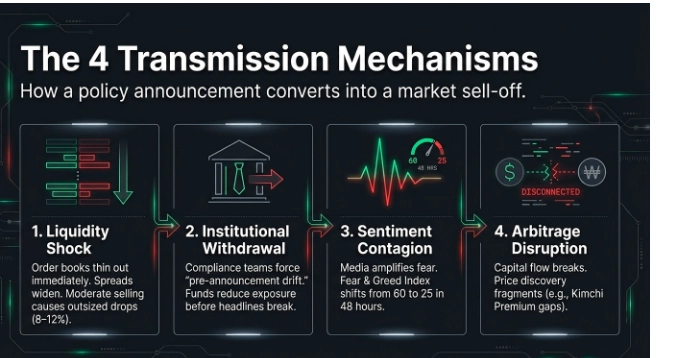
1. Liquidity Shock When a major exchange gets hit with restrictions — say a banking ban or a forced shutdown — the order book thins out immediately. Buyers pull their bids. Sellers panic. The spread between buy and sell price widens. A market with thin liquidity means even moderate sell pressure causes outsized price drops. This is why news that “only affects one exchange” can drop global prices 8–12%.
2. Institutional Withdrawal Cascade This one is the slow bleed. Large institutions — hedge funds, asset managers, family offices — have compliance departments. The moment a regulator issues a warning or starts an enforcement action, compliance teams start reviewing exposure. They don’t wait. They start reducing positions quietly, often before retail even knows what’s happening. This is called pre-announcement drift — abnormal selling volume appears 1–2 days before major SEC actions become public. That’s not coincidence either.
3. Sentiment Contagion Loop Regulatory news hits financial media. Financial media headlines go extreme. Retail investors check their portfolios, see red, and sell. This creates more red. More selling creates more headlines. And the loop runs. The Fear & Greed Index can shift from 60 to 25 within 48 hours of a major regulatory announcement. That emotional cascade is a real price mechanism — not just noise.
4. Cross-Market Arbitrage Disruption Bitcoin trades on hundreds of exchanges globally. When one jurisdiction bans or restricts access, the flow of capital between those exchanges breaks down. Price discovery fragments. You get situations like the “Kimchi premium” in South Korea — where local Bitcoin prices trade 10–20% above global rates because capital can’t flow freely. During regulatory shocks, these gaps widen, creating confusion and more selling pressure.
When government regulations trigger Bitcoin sell-offs, understanding liquidity risk management becomes critical for survival. Regulatory shocks often coincide with exchange restrictions that drain market depth, amplifying price declines beyond fundamental levels. Our crash strategy guide reveals how to position your portfolio when liquidity evaporates during SEC enforcement actions or banking bans, ensuring you’re prepared for the mechanical aspects of regulatory-driven downturns.
Why Do Some Government Bans Crash Bitcoin 40% While Others Only Move It 5%?
The severity of the crash depends on 5 things, not just how harsh the regulation sounds.
Compare two real events:
China 2021 mining and trading ban → Bitcoin dropped ~41% India 2018 banking restrictions → Bitcoin dropped ~15%
Why the difference? China in 2021 represented roughly 65% of global Bitcoin mining hash rate at the time. When that ban hit, it didn’t just spook traders — it threatened the physical infrastructure of the network. The hash rate dropped by 50%. Miners had to shut down, relocate equipment, or sell Bitcoin to cover losses. That’s a supply shock on top of a sentiment shock.
India’s 2018 banking restrictions were harsh — but India’s share of global crypto volume was much smaller, and the ban left loopholes. Less systemic impact.
The five factors that decide severity:
- Market liquidity at the time of announcement — weekend announcements hit harder because fewer market makers are active
- Leverage ratio in the system — high open interest + high funding rates = liquidation cascade potential
- Geographic market share of the affected jurisdiction — China matters more than Paraguay
- Regulatory clarity vs. ambiguity — vague threats sometimes hurt more than clear rules because uncertainty never ends
- Institutional exposure levels — if big money is already heavily in, compliance exits accelerate.
Regulatory announcements frequently top the list of why crypto markets crash suddenly, with government actions capable of wiping billions in market cap within hours. While our broader crash analysis covers multiple catalysts, regulatory shocks remain uniquely destructive due to their uncertainty premium and cross-border contagion effects. Understanding these mechanisms helps distinguish between temporary regulatory panic and fundamental market shifts.
How Quickly Does Bitcoin Price React to Regulatory Shocks?
Faster than most people can respond — which is exactly why retail gets hurt most.
Here’s the actual timeline:
0–5 minutes: Initial shock. Algorithmic traders and institutional desks react first. Price can move 5–16% in this window. By the time you read the headline and open your exchange app, this phase is already over.
1–6 hours: The cascade phase. Stop-losses trigger. Leveraged positions get liquidated. Market makers pull liquidity. This is where the big percentage moves happen.
6–24 hours: Secondary selling. Retail panic hits its peak here. People who didn’t sell in the first hour now see the full damage and sell anyway — usually near the local bottom.
Day 2–7: Evaluation and stabilization. This is where informed traders start looking at on-chain data — are exchange inflows still rising? Are funding rates normalizing? Is the news actually as bad as the price suggests?
Day 7–30: Recovery or continued decline, depending on one thing: regulatory clarity. If the government follows up with clear rules, the market usually recovers in a V-shape. If the uncertainty drags on, you get an L-shaped stagnation.
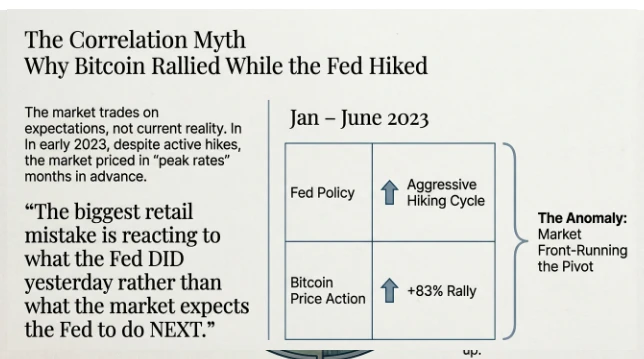
Government monetary policy and interest rate decisions create regulatory-adjacent pressure on Bitcoin, often amplifying the impact of direct crypto regulations. When the Fed tightens policy while the SEC enforces compliance, Bitcoin faces dual headwinds that extend decline duration. Our analysis shows how macro regulatory environments interact with specific crypto enforcement to create compound selling pressure.
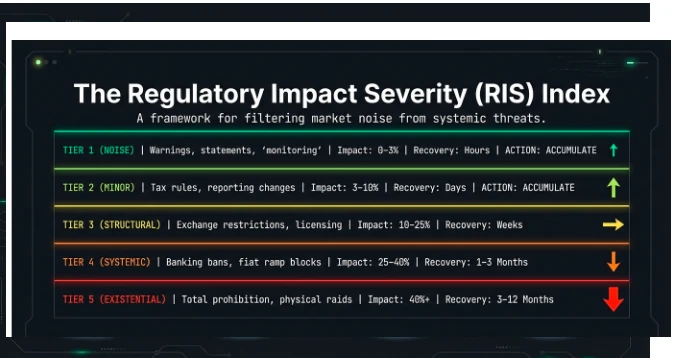
The Regulatory Impact Severity Index: From “Market Noise” to “Full Crash”
Not all regulatory news is equal. Here’s a practical framework to assess severity before reacting.
| Tier | Type of Regulation | Typical Price Impact | Recovery Timeline |
|---|---|---|---|
| Tier 1 | Warnings, statements, “we’re watching” | 0–3% | Hours to 1 day |
| Tier 2 | New tax rules, reporting requirements | 3–10% | 3–7 days |
| Tier 3 | Exchange restrictions, licensing requirements | 10–25% | 2–4 weeks |
| Tier 4 | Banking bans, fiat on/off-ramp restrictions | 25–40% | 1–3 months |
| Tier 5 | Complete prohibitions with enforcement | 40%+ | 3–12 months or longer |
The most underreported thing here: Tier 1 and Tier 2 events are often used by informed traders to accumulate, not exit. The price dip is real, but the long-term impact is minimal. Retail traders who panic-sell a Tier 1 event often sell directly into institutional accumulation.
Despite severe regulatory-driven crashes, Bitcoin has consistently recovered from government attacks throughout its history. This resilience analysis examines whether 2026’s regulatory landscape represents existential threat or typical cycle volatility, providing context for investors fearing permanent decline from SEC actions or international bans. Historical recovery patterns suggest regulatory shocks create buying opportunities.
Is Your Bitcoin Portfolio Actually Vulnerable to the Next Regulatory Shock?
Honestly? That depends on how you’re holding, not just what you’re holding.
The FSB (Financial Stability Board) flagged in October 2025 that “significant gaps and inconsistencies” in global crypto regulation create ongoing systemic risk. That’s not FUD — that’s their actual language. What it means practically is that the regulatory environment is still unstable enough to produce sudden shocks with little warning.
Your actual vulnerability depends on:
- Where your Bitcoin is — on an exchange vs. in a self-custody wallet. If a government forces an exchange to freeze accounts or liquidate holdings, self-custody removes that specific risk
- Whether you’re using leverage — leveraged positions during regulatory shocks get liquidated mechanically, regardless of your personal view on the news
- Exchange concentration — if all your Bitcoin is on one exchange and that exchange faces regulatory action, you have zero diversification
- Your jurisdiction’s regulatory posture — holding crypto in a country with clear, defined rules is structurally safer than holding in a jurisdiction where the rules could flip
Self-custody is the real answer here. A hardware wallet like Ledger or Trezor means your Bitcoin isn’t sitting on an exchange that can be forced to freeze withdrawals. That doesn’t protect you from price drops, but it protects you from the worst scenario — being locked out of your own funds during a crisis.
Bitcoin’s 16-year price history is punctuated by major regulatory battles that temporarily crushed prices before new highs emerged. From China’s repeated bans to SEC ETF rejections, understanding this regulatory cycle helps contextualize current government actions. Our historical timeline maps every significant regulatory shock against Bitcoin’s long-term trajectory, revealing patterns that inform future decline predictions.
Why Did Bitcoin Drop When the SEC Merely Mentioned Enforcement — Before Any Actual Action?
Because anticipation pricing is real, and the market often prices in the worst-case scenario before facts are confirmed.
When the SEC issues a Wells Notice — which is essentially a formal warning that enforcement action is coming — prices move before any actual charges. This happened with Crypto.com in October 2024. Just the notice caused immediate selling pressure. When the SEC closed that investigation without action in March 2025, CRO (Crypto.com’s token) rallied 12%.
Think about what that tells you. The market priced in the worst case. The worst case didn’t happen. Price recovered.
This pattern repeats. It means that during SEC enforcement cycles, the worst price action often happens before the resolution — not after. Retail who sell on the Wells Notice announcement often sell right before the recovery that follows if the case gets dropped or settles favorably.
That said — not every investigation ends favorably. The key is to assess whether the underlying regulatory issue is a serious one with broad market implications, or a specific company-level issue. Company-level enforcement hurts that company’s token. Broad crypto classification rulings affect the whole market.
Could a Single Government Announcement Trigger a Billion-Dollar Liquidation Cascade?
Yes. And it already happened.
In October 2025, comments related to Trump’s tariff policy triggered the largest crypto liquidation event ever recorded — approximately $19 billion in positions wiped out. That’s not a Bitcoin-specific vulnerability. That’s what happens when you combine:
- High open interest across derivatives markets
- Thin weekend liquidity (fewer market makers active)
- Automated liquidation systems that trigger sequentially
- Cross-asset contagion from macro news hitting risk assets broadly
When a large position gets liquidated, it creates downward price pressure. That pressure triggers the next leveraged position’s stop-loss. That liquidation creates more pressure. The cascade runs until either: the leverage is fully flushed out, or a major buyer steps in.
Insurance funds on exchanges like Binance or Bybit are supposed to absorb some of this. But when the cascade is large enough, even insurance funds get depleted, triggering auto-deleveraging — where profitable traders on the other side of the trade get their positions partially closed to cover the losses. That’s the nuclear option, and it happens more often during regulatory shocks than any other trigger.
Which Regulatory Actions Actually Boosted Bitcoin Prices?
This part almost never gets covered. Some regulation is bullish — and understanding which kind is genuinely useful.
When the SEC finally approved Bitcoin spot ETFs in January 2024, Bitcoin rallied significantly — and the ETF approval cycle drove substantial inflows in the months that followed. Clear, structured regulatory frameworks reduce the “jurisdictional risk premium” that informed traders demand to hold an asset in legal uncertainty.
In March 2025, President Trump signed an executive order establishing a Strategic Bitcoin Reserve — directing the government to hold Bitcoin acquired through asset forfeitures rather than sell it. That’s a direct supply reduction signal. Less selling pressure from government holdings = structural price support.
The EU’s MiCA (Markets in Crypto-Assets) regulation, once it became clear and enforceable, actually brought institutional capital back into European crypto markets because compliance teams finally had a clear framework to work within.
So the pattern is: ambiguity = negative for price. Clarity = can be positive, even if the rules are strict.
Strict rules that are clear are better for markets than vague rules that could go either way. Markets can price in strict. They can’t price in uncertainty.
How Do China’s Bitcoin Mining Bans Affect Price Even If You’re Outside China?
Because Bitcoin’s price isn’t just about demand — it’s also about mining economics, and those are global.
When China banned mining in 2021, roughly 50% of global hash rate went offline almost overnight. The Bitcoin network’s difficulty — which automatically adjusts to keep block times around 10 minutes — couldn’t adjust fast enough. Blocks started coming slower. Transaction confirmations slowed. Mining elsewhere became suddenly more profitable.
For price: the sudden hash rate drop created uncertainty about the network’s short-term stability. That uncertainty = selling. But then something interesting happened. Mining operations relocated to Kazakhstan, the US, and Canada. Hash rate recovered within about 6 months. Bitcoin eventually went on to hit new all-time highs.
The long-term effect of the China ban was actually to decentralize Bitcoin mining. That’s structurally healthier for the network — and arguably reduced the geopolitical risk premium that China-concentrated mining had created.
But in the short term — 1 to 3 months — the price impact was severe. The lesson: mining bans from dominant hash rate countries create real short-term pressure, and the recovery depends on how quickly mining relocates.
What Happens When Governments Can’t Decide If Bitcoin Is a Currency, Commodity, or Security?
Regulatory classification confusion is its own form of damage — it’s a slow tax on price.
In the US, you have a three-way fight:
- The CFTC treats Bitcoin as a commodity
- The SEC has historically claimed jurisdiction over many crypto assets as securities
- The IRS treats Bitcoin as property for tax purposes
Three different agencies, three different classifications, zero consensus. For institutional investors, this is a compliance nightmare. They can’t allocate large capital to an asset where the legal framework is genuinely unclear, because a wrong classification decision could mean regulatory liability.
So they either don’t enter the market, or they enter at a discount — demanding a higher expected return to compensate for that uncertainty. That discount is built into the price. Every day of classification confusion is a slight suppressor on Bitcoin’s price ceiling.
When the confusion starts to resolve — as it did somewhat with the ETF approvals — that discount starts to compress, which is partly why regulatory clarity events can be price-positive even when they come with restrictions.
The V-Shaped vs. L-Shaped Recovery: How to Know Which One Is Coming
After a regulatory shock, Bitcoin either bounces back fast or grinds sideways for months. Here’s what determines which.
V-shaped recovery happens when:
- The regulatory announcement comes with clear, defined rules
- The affected jurisdiction has limited market share
- Leverage was flushed out quickly in the initial crash
- No secondary enforcement action follows
L-shaped stagnation happens when:
- Regulatory uncertainty continues — investigations, appeals, ongoing legal proceedings
- The announcement opens the door to broader industry-wide scrutiny
- Institutional investors remain in compliance review mode
- Other negative macro factors coincide (rate hikes, equity market weakness)
W-shaped (double dip) happens when:
- Initial recovery prompts new regulatory pushback
- A settlement or resolution is followed by a harsher-than-expected ruling
- Government “walks back” initial pro-crypto statements with new restrictions
Identifying which pattern is forming early requires watching on-chain data: exchange inflows (are people moving Bitcoin onto exchanges to sell, or withdrawing to wallets?), funding rates (is leverage rebuilding, or staying flat?), and open interest trends. These tell you what the market is doing, not just what it’s feeling.
What Smart Money Watches in the 72 Hours After a Regulatory Shock
Not price. Position data.
In the first 6 hours, smart money is watching:
- Exchange net inflows — rising inflows mean more selling pressure incoming
- Funding rates — if funding goes deeply negative, short sellers are piling in, but it also signals potential for a short squeeze
- Open interest — dropping OI means positions are closing (either liquidation or exit). Stabilizing OI means the flush is over
By hour 24, the question becomes: is the news actually as bad as the price suggests? This requires reading the actual regulatory document, not just the headline. Many regulatory “crackdowns” that get reported as existential threats are actually narrow in scope when you read the text.
By day 3, a clearer picture emerges. If the initial panic overshot — which it often does — recovery candidates become visible. But this requires staying out of margin, staying in self-custody, and having dry powder available. None of which is possible if the regulatory shock caught you over-leveraged on an exchange that just froze withdrawals.
The Bottom Line
Government regulations can and do cause Bitcoin price declines. The mechanism is real, the data supports it, and the pattern repeats. But the story is more nuanced than “government bad, Bitcoin drops.”
The severity depends on: which government, what type of action, how much leverage is in the market, and whether clarity or confusion follows. Some regulatory actions are actively bullish. Most price crashes driven by regulation recover — the timeline depends on what comes next.
The practical takeaway is simple but important:
- Self-custody protects you from exchange-level regulatory risk
- Avoiding leverage protects you from liquidation cascades during regulatory shocks
- Understanding the Tier 1–5 severity framework helps you avoid panic-selling Tier 1 noise
- Regulatory clarity, even when strict, tends to be price-positive over time
- Ambiguity is the real long-term price suppressor — not the regulation itself
Bitcoin has survived bans from China, enforcement waves from the SEC, banking restrictions, tax crackdowns, and classification confusion. It hasn’t survived those events painlessly. But it has survived them. That track record is part of the data too.