How to Buy Crypto Without SSN
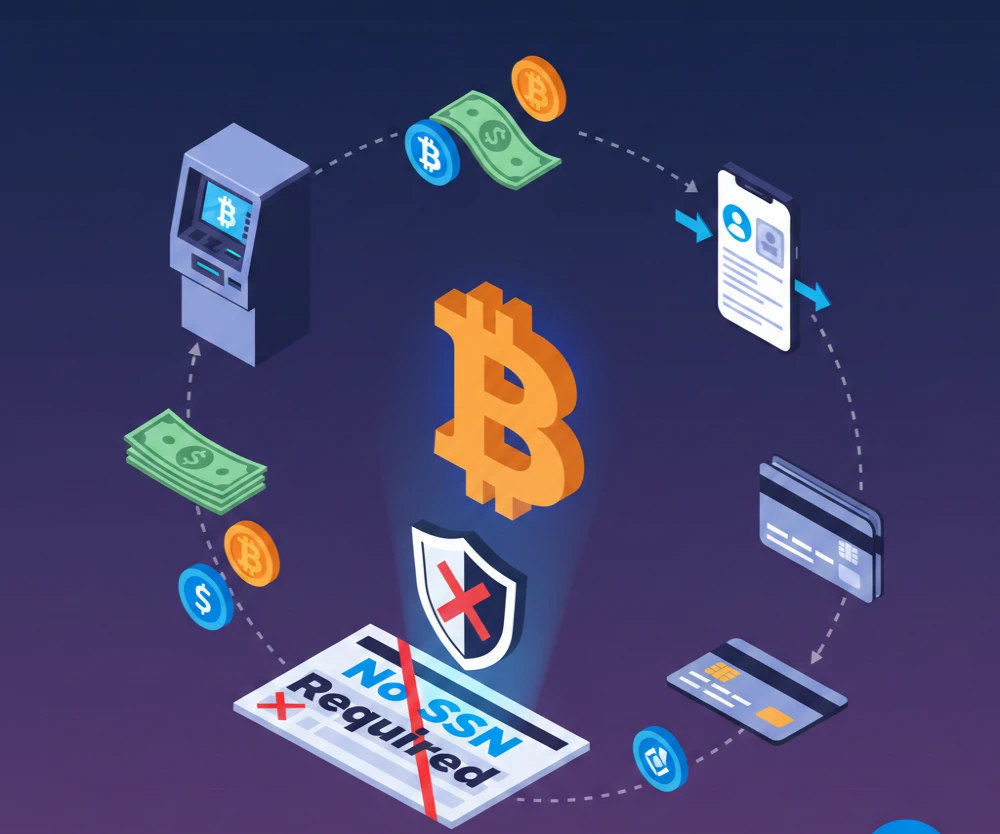
You can Buy Crypto Without SSN using Bitcoin ATMs (up to $1,000-$10,000 depending on location), peer-to-peer platforms like Bisq or Hodl Hodl, decentralized exchanges such as Uniswap, prepaid debit cards (up to $2,500), or by providing alternative IDs like ITIN, EIN, or passport on select exchanges. Each method has different purchase limits, fees, and privacy levels—Bitcoin ATMs offer speed but charge 8-15% fees, while DEXs provide better privacy but require technical knowledge.
The real question isn’t just “can you buy crypto without SSN”—it’s whether you’re doing it for legitimate privacy reasons or trying to avoid regulatory tracking that could backfire during tax season.
Why People Search for No-SSN Crypto Methods
Three types of people end up here:
Non-US citizens waiting for SSN: You’re legally in the US (work visa, student visa, pending green card) but your Social Security Number hasn’t arrived yet. Meanwhile, you want to buy crypto now, not in 6-8 weeks.
Privacy-focused buyers: You understand that every KYC exchange reports to IRS via Form 1099-DA (new requirement from 2025). You’re not hiding income—you just don’t want Coinbase, Binance, or Kraken creating a permanent database linking your identity to every wallet address you’ve ever used.
People with verification problems: Maybe your credit is frozen, your ID expired, or you’re facing identity theft issues. Traditional exchanges reject you even though you’re a legitimate buyer.
Here’s what most articles won’t tell you: buying crypto without SSN isn’t illegal by itself, but how you handle taxes afterward determines whether you’re practicing privacy or committing tax evasion. That line matters more than the purchase method.
Best No-SSN Method Based on How Much You’re Buying
Under $500: Use a Bitcoin ATM with cash. Fastest option. Expect to pay 8-12% in fees but you’ll have Bitcoin in your wallet within 5 minutes. No ID needed for amounts under $1,000 at most machines.
$500-$1,000: ChangeHero or SimpleSwap let you buy up to $700-$1,000 with just email and phone number. Fees around 3-5%. Takes 15-30 minutes for first-time buyers.
$1,000-$5,000: Peer-to-peer exchanges like Bisq or Hodl Hodl. You’ll need patience (trades take 30 minutes to 2 hours) and basic technical skills. Fees vary by seller but usually 1-3% above market price.
Over $5,000: Decentralized exchanges (Uniswap, SushiSwap) if you already have some crypto to swap, or OTC desks that accept ITIN/EIN instead of SSN. These require either existing crypto holdings or alternative tax IDs.
If you have ITIN or EIN: Kraken and some international exchanges accept Individual Taxpayer Identification Numbers or Employer Identification Numbers. You can buy larger amounts ($10,000+) with better fees than anonymous methods.
The method you choose should match your technical comfort level, not just the amount. A $2,000 purchase on a DEX might save you 5% in fees compared to a Bitcoin ATM, but if you’ve never used MetaMask or understand gas fees, you could lose $200 making mistakes.
SSN Alternatives That Actually Work at Real Exchanges
Most guides skip this entirely. If you don’t have an SSN but you’re legally in the US, you have three alternatives that some exchanges accept:
ITIN (Individual Taxpayer Identification Number)
This is what the IRS issues to people who need to pay taxes but don’t qualify for an SSN. If you’re a resident alien, nonresident alien filing a US tax return, or a dependent/spouse of a visa holder, you can get an ITIN.
Which exchanges accept it: Kraken is the most reliable. During signup, where it asks for SSN, select “I don’t have an SSN” and enter your ITIN instead. Their system recognizes it as a valid tax ID.
Purchase limits: Same as SSN users once verified—$25,000+ daily depending on your verification level.
What you need: Form W-7 filed with IRS, supporting documents proving foreign status and US tax filing requirement. Takes 7-11 weeks to receive ITIN by mail.
The catch: If you later get an SSN, you must notify the IRS and update all your accounts. Kraken will ask you to re-verify with your SSN. This creates a connection between your ITIN and SSN in IRS records.
Tax implications: You’re filing US taxes anyway with an ITIN, so your crypto transactions get reported the same way as SSN holders. No privacy benefit—just access to regulated exchanges while you wait for SSN.
EIN (Employer Identification Number)
This is designed for businesses, but if you operate as a sole proprietor, LLC, or any business entity, you can get an EIN within minutes online.
Which exchanges accept it: Coinbase Pro (not regular Coinbase), Gemini’s institutional accounts, and most OTC desks. You’ll need to sign up as a business account, not individual.
Purchase limits: Usually higher than personal accounts—$50,000 to $100,000+ daily, but you’ll face enhanced due diligence for large transactions.
What you need: Legal business entity registered in the US (even a single-member LLC works), business bank account, and actual business purpose for crypto purchases.
The catch: You can’t use personal funds. The money must come from your business bank account. Your crypto purchases become business expenses/assets, which affects how you report taxes—more complex than personal capital gains.
When this makes sense: If you’re legitimately running a business that accepts crypto payments, needs to hold crypto as treasury assets, or operates in crypto-related services. Don’t create a fake business just to bypass SSN requirements—IRS audits business accounts more aggressively than personal ones.
Passport + Foreign Address
Some international exchanges with US access accept passport instead of SSN, but you need a non-US address.
Which platforms: Bybit, KuCoin, and BitGet allow passport verification without SSN. However, they’re technically not licensed to serve US customers.
The legal gray area: These exchanges don’t explicitly ban US users, but they don’t comply with US regulations either. If you’re using a US IP address, they’ll eventually ask for additional verification or freeze your account.
What happens: You can buy crypto, but withdrawing large amounts triggers compliance checks. Some users report frozen accounts until they provide SSN or proof they’re not US residents.
The VPN question: Using a VPN to appear from another country violates most exchanges’ terms of service. If they detect it (and they do, through browser fingerprinting and payment method tracking), they can seize your funds.
My take: This method works temporarily but fails exactly when you need it most—during withdrawal. Not worth the risk unless you’re genuinely a non-US resident traveling in the US temporarily.
Method 1: Bitcoin ATMs (The Fastest but Most Expensive)
Walk up with cash, scan a QR code from your wallet, insert bills, receive Bitcoin in 5-10 minutes. That’s the appeal.
How the ID requirement works: Federal law requires ATMs to collect ID for purchases over $1,000 per day. Below that threshold, most operators don’t ask—but some still do. The machine’s screen will tell you before you insert cash.
Finding no-ID ATMs: CoinATMRadar shows locations and whether they require ID. Filter by “ID required: No” but call ahead because operators change policies without updating the website.
Actual limits I’ve tested:
- $500 or less: 95% of ATMs don’t ask for ID
- $501-$999: About 60% still don’t require ID
- $1,000-$2,999: ID required but sometimes just phone number
- $3,000+: Always requires government-issued ID, sometimes SSN
Fee structure that hurts:
- Purchase fee: 8-15% above market price (not a flat fee—percentage of your purchase)
- Network fee: $2-$5 additional for Bitcoin transaction
- Example: You insert $500, the ATM gives you $425-$450 worth of Bitcoin
What to do:
- Download a non-custodial wallet (BlueWallet for Bitcoin, Trust Wallet for multiple coins)
- Generate a new receiving address
- Write down your recovery phrase on paper—NOT on your phone
- Go to ATM location during business hours (safer, cameras working)
- Select “Buy Bitcoin” and enter the amount
- Scan your wallet’s QR code when prompted
- Insert cash slowly (machines jam frequently)
- Wait for confirmation screen—take a photo of transaction ID
- Check your wallet in 10-30 minutes for Bitcoin arrival
What NOT to do:
- Don’t use the ATM’s “create wallet” option—you won’t own the private keys
- Don’t buy more than you can afford to lose in fees
- Don’t use the same ATM repeatedly for large amounts (triggers manual review)
- Don’t use fake names if ID is required (federal offense)
When ATMs make sense: You need crypto within hours, you’re buying $300-$800, and the 10% fee doesn’t bother you. For anything else, cheaper methods exist.
Regional differences that matter:
- New York: Most ATMs require ID even for small amounts (BitLicense regulations)
- California: More relaxed, $900 often possible without ID
- Texas: Very permissive, some ATMs allow up to $2,500 without ID
- Wyoming: Crypto-friendly state, fewer restrictions
Method 2: Peer-to-Peer Exchanges (Bisq, Hodl Hodl, RoboSats)
This is where you trade directly with another person, no company in the middle. Think Craigslist for Bitcoin, except safer.
Bisq: The Most Private Option
Bisq is software you download and run on your computer. It’s not a website—it’s a decentralized network where buyers and sellers match directly.
How it actually works:
You deposit a security bond (small amount of Bitcoin) that gets locked in multisignature escrow. When you find a seller, you send them payment via bank transfer, Zelle, Cash App, or even cash by mail. They release Bitcoin from escrow once payment arrives. If someone tries to scam, arbitrators (random Bisq users) review evidence and decide who gets the escrowed funds.
Step-by-step first purchase:
- Download Bisq from bisq.network (verify the PGP signature—important)
- Install and wait 1-2 hours for it to sync the network (uses Tor automatically)
- Create a payment account: Settings → Account → National Currency Accounts → Add New Account
- Choose your payment method (Zelle works fastest for US buyers)
- Browse Buy Offers: Click “Buy BTC” tab and filter by your payment method
- Select offer with reasonable price (usually 2-5% above Coinbase price)
- Click “Take offer to buy BTC” and enter amount
- Send payment to seller within the time window (usually 1-24 hours depending on method)
- Mark payment as sent in Bisq
- Wait for seller confirmation (30 minutes to 12 hours)
- Bitcoin arrives in your Bisq wallet
- Transfer to your personal wallet immediately
Actual limits:
New accounts: 0.01 BTC per trade (~$500 at $50,000 BTC price) After 30 days: 0.04 BTC per trade (~$2,000) After 2 months: 0.1 BTC per trade (~$5,000) Signed account (requires time-lock): 0.25 BTC+ per trade
The time investment: Your first trade takes 2-4 hours total including setup. After that, trades take 30 minutes to 2 hours depending on payment method.
Fees:
- Maker (creating an offer): 0.1% of trade
- Taker (accepting an offer): 0.3% of trade
- Security deposit: 15% of trade amount (refunded after successful trade)
- Mining fees: Variable, usually $3-$10
What can go wrong:
Payment reversals: If you use a reversible method (PayPal, credit card chargeback), sellers won’t accept it or will charge 20%+ premium.
Seller doesn’t release Bitcoin: Rare but happens. You’ll need to open a dispute and provide proof of payment. Takes 3-5 days to resolve.
Your payment account gets flagged: If you mark a Zelle payment “buying Bitcoin,” Zelle might freeze your account. Just write “Thanks for dinner” or leave it blank.
Who should use Bisq: People comfortable with technical software, willing to wait longer for trades, and buying $500-$5,000 per month. Not ideal for crypto beginners or people needing instant purchases.
Hodl Hodl: Easier Interface, Less Privacy
Similar concept to Bisq but it’s a website, not decentralized software. The trade-off: easier to use, but the company can see your trades.
Key differences:
- No software download—just create account with email
- No security deposit required for buyers (sellers deposit)
- Faster trades (20-60 minutes average)
- Accepts more payment methods
- But: website can be seized, accounts can be frozen, and they know your email/payment details
Limits:
- First trade: $100-$1,000
- Verified email + trades: $5,000
- Long-term users: $10,000+
My experience: Easier first-time experience than Bisq, but you’re trusting the Hodl Hodl company more. Fine for occasional purchases, not ideal if privacy is your main concern.
RoboSats: Lightning Network P2P
Newest option, works on Bitcoin’s Lightning Network (instant, low-fee Bitcoin transactions).
The advantage: Trades complete in 15-30 minutes because Lightning is fast. Fees under $1 typically.
The limitation: You need to receive Bitcoin on Lightning Network, then convert to regular Bitcoin. Adds complexity.
Best for: Experienced Bitcoin users who already use Lightning wallets (Phoenix, Breez). Not recommended for beginners.
Method 3: Decentralized Exchanges (Uniswap, SushiSwap, PancakeSwap)
These only work if you already have cryptocurrency. You can’t buy crypto with dollars on a DEX—you can only swap one crypto for another.
The real use case: You bought Ethereum on a Bitcoin ATM or P2P platform. Now you want to swap some ETH for USDC (stablecoin), or ETH for an altcoin. DEXs let you do this without ID.
How Uniswap works:
- You need a Web3 wallet (MetaMask is most common)
- You need ETH in that wallet (to pay gas fees and to swap)
- Go to app.uniswap.org
- Connect your wallet
- Select tokens to swap (from → to)
- Approve the transaction (costs gas fee)
- Confirm the swap (costs another gas fee)
- Tokens appear in your wallet in 15 seconds to 2 minutes
Gas fees shock: During network congestion, a single swap can cost $20-$100 in ETH just for the transaction fee. Check current gas prices at etherscan.io/gastracker before swapping.
Slippage settings: This determines how much price movement you’ll tolerate.
- 0.5% slippage: Your trade might fail if price moves
- 2-3% slippage: Standard setting
- 5%+ slippage: You’ll overpay but trade will succeed
What NOT to do on DEXs:
- Don’t buy random tokens you see trending (99% are scams)
- Don’t connect your wallet to sites you don’t trust (they can drain funds)
- Don’t swap entire ETH balance (leave some for gas fees)
- Don’t panic-cancel a pending transaction (costs gas with no benefit)
Alternatives to Ethereum DEXs:
- PancakeSwap (Binance Smart Chain): Lower fees ($0.20-$2), but need BNB for gas
- SushiSwap (multiple chains): Similar to Uniswap, available on cheaper networks
- TraderJoe (Avalanche): Fast and cheap ($0.50 typical gas fee)
Tax warning for DEX users: Every swap is a taxable event. If you bought ETH at $1,500 and swap it when ETH is $3,000, you owe capital gains tax on that $1,500 profit—even if you just swapped to another token.
Method 4: Prepaid Debit Cards and Gift Cards
You buy a prepaid Visa/Mastercard with cash, then use it on crypto exchanges that don’t require SSN for small purchases.
How this actually works:
Step 1: Buy prepaid card at Walmart, CVS, or gas station with cash
- Vanilla Visa: Up to $500 per card, $5.95 activation fee
- Green Dot: Up to $1,000 per card, $7.95 fee
- NetSpend: Reloadable up to $5,000, monthly fees apply
Step 2: Activate card online (requires name and ZIP code only, not SSN)
Step 3: Use on crypto platforms:
- ChangeHero: Accepts prepaid cards up to $700 per transaction
- SimpleSwap: Up to $1,000 with just email
- Paybis: Up to $500 initially
Why this method is declining:
Card networks (Visa/Mastercard) now flag crypto purchases as high-risk. Many prepaid cards outright block crypto transactions. Success rate in 2025: about 40% of prepaid cards work.
Testing before you load money:
Buy the cheapest card first ($25-$50), try a small crypto purchase. If it works, then buy larger denomination cards. If declined, you only wasted $5 in fees.
The velocity problem:
Even if first purchase works, buying crypto repeatedly with prepaid cards triggers fraud alerts. After 2-3 successful purchases, the next one gets blocked.
Tax reporting gap:
Prepaid cards don’t report to IRS because they’re not linked to your SSN. But the crypto you buy still creates taxable events when you sell or spend it. You’re required to track cost basis manually.
Method 5: Crypto ATMs That Accept Alternative IDs
Different from regular Bitcoin ATMs—these are newer machines that accept:
- Passport
- State ID
- Driver’s license (without SSN verification)
- Even foreign IDs in some cases
How to find them: CoinFlip and Bitcoin Depot operate these machines. Their apps show which locations accept alternative ID.
The verification process:
- Machine scans your ID
- Takes your photo (facial recognition)
- Asks for phone number
- Sends SMS code
- Links ID to phone number, not SSN
Limits with alternative ID:
- Daily: $3,000-$10,000
- Monthly: $10,000-$25,000
- Varies by operator and state regulations
The privacy factor: Less private than cash-only ATMs because your face and ID are recorded. More private than Coinbase because data isn’t automatically sent to IRS.
Where this fails: New York, Washington, and Hawaii have stricter regulations. Even with alternative ID, limits drop to $1,000-$2,000 daily.
Method 6: Mining (Earning Instead of Buying)
Technically you’re not buying—you’re receiving newly created Bitcoin or other cryptocurrency as payment for providing computing power.
Is this realistic in 2025?
Bitcoin mining at home: No. Unless you have free electricity and $5,000+ for ASIC miners, you’ll lose money.
GPU mining (Ethereum alternatives): Maybe. If you have a gaming PC with Nvidia RTX 3060+ or AMD 6800+, you might earn $1-$3 per day mining Ravencoin or Ergo.
Cloud mining: Scam 99% of the time. Companies take your money and either pay tiny returns or disappear.
What actually works for small-scale earning:
Helium mining (HNT): Deploy a hotspot device ($300-$500), earn crypto for providing network coverage. Returns: $5-$50/month depending on location.
Presearch (PRE): Get paid crypto for web searches. Passive, but earnings are tiny ($1-$5/month).
Brave browser (BAT): See privacy-respecting ads, earn Basic Attention Tokens. Maybe $3-$10/month.
The tax headache: Mined crypto is taxed as income at fair market value when received. If you mine 0.01 ETH when ETH is $3,000, that’s $30 of taxable income, even if you don’t sell.
Why people consider this: It’s the only way to get crypto that’s truly “earned” not purchased. No KYC, no exchange, no trace—except you still report it as income on taxes if you’re following the law.
State-by-State Legal Reality Check
Federal law doesn’t ban buying crypto without SSN. But state money transmission laws and local regulations create huge variance.
States Where Anonymous Buying is Heavily Restricted:
New York: BitLicense requirements mean most no-KYC options don’t operate here. Bitcoin ATMs require ID for any amount over $500. P2P trading is legal but most sellers won’t serve NY residents due to regulatory risk.
Hawaii: All crypto exchanges must be licensed by the state. No-KYC platforms avoid Hawaii entirely. Bitcoin ATMs exist but require full KYC even for small amounts.
Washington: Similar to Hawaii. Strong money transmission enforcement. BitFloor and several other exchanges exited Washington rather than comply.
States Where It’s More Permissive:
Wyoming: Most crypto-friendly state. Specific laws exempting small crypto transactions from money transmitter requirements. Bitcoin ATMs commonly allow $2,000+ without ID.
Texas: No state-level BitLicense equivalent. Federal rules apply but enforcement is relaxed. Large P2P community.
Florida: No state income tax helps, and crypto regulations are moderate. Bitcoin ATMs plentiful with higher no-ID limits.
Montana: Low population, minimal state oversight. Bitcoin ATMs often have highest limits ($10,000+ with just phone number).
The Traveling Buyer Strategy:
Some people travel to nearby permissive states to use Bitcoin ATMs. Legal? Yes. Smart? Depends on whether driving 4 hours to save 5% in fees makes sense.
What happens if you’re caught buying illegally?
“Illegally” is the wrong word—buying crypto without SSN isn’t itself illegal. What gets people in trouble:
- Structuring: Making multiple purchases just under reporting limits to avoid tracking (federal crime)
- Unlicensed money transmission: Running a P2P exchange business without state licenses
- Tax evasion: Not reporting crypto income and gains
Buying $500 of Bitcoin at an ATM without ID? Zero legal risk.
Buying $500 of Bitcoin every day for a year without ID, never reporting it on taxes? That’s structured tax evasion.
2025 Regulatory Changes You Need to Know
IRS Form 1099-DA (Started January 2025)
Every crypto exchange now reports your transactions to IRS using new Form 1099-DA. This replaces the old 1099-K and 1099-B mess.
What it reports:
- Total proceeds from sales
- Cost basis (if exchange has it)
- Dates of acquisition and sale
- Type of digital asset
Who reports it:
- Centralized exchanges: Coinbase, Kraken, Gemini, all of them
- Payment processors accepting crypto: BitPay, Coinbase Commerce
- Maybe in future: Bitcoin ATM operators (unclear if 2025 or 2026)
What this means for no-SSN buyers:
If you buy on Bisq or Bitcoin ATM without SSN, those transactions don’t appear on Form 1099-DA. But when you eventually sell, deposit to an exchange, or spend—if that happens on a platform that has your SSN—the IRS sees a sale with no purchase record.
The cost basis problem:
IRS assumes zero cost basis if you can’t prove what you paid. Sell $5,000 of Bitcoin you bought anonymously? IRS thinks you owe taxes on the full $5,000, not just your profit.
How to protect yourself:
Keep receipts. Bitcoin ATM emails you a receipt. Bisq shows trade history. Screenshot everything. When you file taxes, you report these purchases on Form 8949 as “not reported to IRS” transactions.
FinCEN Travel Rule Enforcement (2024-2025)
Financial Crimes Enforcement Network now requires exchanges to collect sender/receiver information for crypto transactions over $3,000.
What this breaks:
Withdrawing from Coinbase to your personal wallet? If it’s over $3,000, Coinbase asks “what’s the destination wallet’s owner info?”
You can still withdraw, but there’s a record of where you sent it. Not exactly anonymous anymore.
Workarounds people use:
Multiple smaller withdrawals (under $3,000 each). But this is literally the definition of structuring—illegal if done to evade reporting.
Better approach: Withdraw to your wallet in larger amounts, accept that the exchange knows your wallet address, but at least it’s not a KYC’d exchange wallet.
Tornado Cash Sanctions Update (March 2025)
Treasury Department’s OFAC sanctioned Tornado Cash (crypto mixer) in 2022. Recent court ruling partially lifted sanctions, but using it is still legally risky.
What it means: Mixing services (tools that obscure transaction history) are in legal gray area. Some work, some will get you flagged.
Practical impact: If you’re trying to enhance privacy after buying crypto without SSN, using a mixer can trigger exchange account freezes if you later deposit to a KYC exchange.
Tax Implications Nobody Talks About
You bought crypto without SSN, didn’t go through a KYC exchange. IRS still expects you to report it.
How IRS Actually Tracks Anonymous Crypto:
Blockchain analysis companies: Chainalysis, Elliptic, CipherTrace sell tracking software to IRS. They can:
- Link wallet addresses to exchange accounts
- Trace Bitcoin ATM purchases through blockchain
- Identify P2P trade patterns
- Flag large transactions
Where you get caught:
Not during the purchase. You get caught when you:
- Sell on Coinbase/Kraken (deposit from unknown source)
- Spend on major merchants accepting crypto
- Convert to cash through bank account
- Buy a house/car and can’t explain income source
The audit trigger:
IRS questions anyone who shows crypto sales on 1099-DA but no corresponding purchases. You must explain where crypto came from.
How to Report Anonymous Purchases Correctly:
Form 8949 line entry:
“Bought 0.05 BTC via Bitcoin ATM (no Form 1099-DA issued) on [date]”
- Cost basis: $2,500 (ATM receipt amount)
- Sale price: $3,000 (when you sold it later)
- Gain: $500
What supporting documents to keep:
- Bitcoin ATM email receipts (has transaction ID)
- Bisq trade history exports (CSV file)
- Screenshots of purchase confirmations
- Bank/Zelle/Cash App records showing payment sent
The statute of limitations trick:
IRS has 3 years to audit after you file (6 years if you underreported income by 25%+). Keep records for at least 6 years.
Privacy Coins and Tax Reporting (Monero, Zcash)
Some people buy Bitcoin without SSN, then swap to Monero because it’s untraceable. Tax-wise, this creates problems.
The law: Every crypto-to-crypto swap is taxable. BTC → XMR swap triggers capital gains.
The enforcement challenge: IRS can’t see Monero transactions after the swap. But they can see you withdrew BTC from an exchange, and now you can’t explain where it went.
The audit scenario:
IRS: “You withdrew $10,000 of Bitcoin to unknown wallet. Where is it now?” You: “I sold it peer-to-peer for cash.” (Legal, but you owe taxes on gains) You: “I lost the keys.” (Possible, but suspicious if large amount) You: “I swapped to privacy coin.” (Legal, but now you admit you have unreported assets)
The actual risk: Very low chance of audit if under $50,000 in annual crypto activity. Higher chance if you show lifestyle inconsistent with reported income (bought house, expensive car, but claim low income).
Common Mistakes That Expose Your Identity (Even With No-KYC Methods)
Mistake 1: Reusing Wallet Addresses
You buy Bitcoin at ATM, receive it to address 1abcd. Later you buy more Bitcoin at ATM, use same address. Now both purchases are linked publicly on blockchain.
Solution: Generate new receiving address for every purchase. All wallets allow this.
Mistake 2: Connecting to Exchange After Anonymous Purchase
You buy $5,000 Bitcoin on Bisq. Send it directly to Coinbase to sell. Coinbase sees Bitcoin came from P2P trade, might ask for source of funds.
Solution: Use an intermediary wallet. Bisq → your personal wallet → wait a day → Coinbase. Not perfect privacy, but less obvious.
Mistake 3: Forgetting IP Address Tracking
You buy on “anonymous” P2P exchange but use your home internet. Your IP address is logged, and your ISP can be subpoenaed.
Solution: Use a no-logs VPN (Mullvad, ProtonVPN) or Tor network. But read exchange terms—some ban VPN users.
Mistake 4: Payment Apps That Record Reason
You send Zelle payment to Bisq seller, write “Bitcoin purchase” in memo. Your bank sees this, might file Suspicious Activity Report (SAR).
Solution: Leave payment memo blank or write something generic. Sellers understand.
Mistake 5: Buying Too Much Too Fast
You buy $10,000 in one week across multiple Bitcoin ATMs. Operators notice pattern, report to FinCEN.
Solution: Spread purchases over time. $1,000 per week is normal. $10,000 in one day triggers attention.
The Risk Matrix: Safety vs. Privacy vs. Cost
Here’s the honest comparison of all methods:
| Method | Privacy Level | Cost (Fees) | Speed | Legal Risk | Technical Difficulty |
|---|---|---|---|---|---|
| Bitcoin ATM | Medium | 8-15% | 5 mins | Low | Very Easy |
| Bisq P2P | Very High | 1-3% | 2-4 hours | Low | Medium |
| Hodl Hodl | High | 1-4% | 30-90 mins | Low | Easy |
| DEX (Uniswap) | High* | 0.3% + $5-50 gas | 2 mins | Low | Hard |
| Prepaid cards | Medium | 3-5% + card fee | 15 mins | Low | Easy |
| ITIN/EIN exchanges | Low | 0.1-0.5% | Hours-Days | Very Low | Easy |
| Mining | Very High | Hardware cost | Continuous | Low | Hard |
*DEX privacy only applies if you already have crypto. Getting initial crypto still requires another method.
The reality: No single method is best for everyone.
If you need $300 of Bitcoin today and don’t care about 10% fee → Bitcoin ATM
If you’re buying $5,000 and willing to learn technical tools → Bisq
If you have ITIN and want lowest fees → Kraken with ITIN
If you already have crypto and want to swap → DEX
Scam Warning Signs in No-KYC Crypto
Because you’re avoiding regulated exchanges, scammers target you. Here’s what to watch for:
“Too good to be true” P2P sellers: Bitcoin is $50,000, but someone offers to sell you Bitcoin for $45,000 with no escrow. Scam 100% of the time.
Bitcoin ATMs in sketchy locations: Legitimate ATM operators choose visible locations (convenience stores, malls). ATM in unmarked building’s basement? Could be a trap to rob you.
Exchanges asking for SSN after you deposit: Some shady exchanges let you deposit without KYC, then require SSN to withdraw. Your crypto is stuck until you KYC or forfeit it.
Recovery phrase phishing: Someone messages you saying “verify your wallet for IRS compliance, enter recovery phrase here.” No legitimate service asks for your recovery phrase.
Fake Bisq/DEX software: Download Bisq from bisq.network ONLY. Fake versions on other sites steal your Bitcoin.
Telegram/WhatsApp sellers: Person offers to sell you crypto via Telegram, asks you to send payment first. You’ll never hear from them again.
The verification: Before using any platform:
- Google “[platform name] scam” and check recent results
- Verify SSL certificate on website
- Check domain age (scam sites are usually under 6 months old)
- Look for real office address and company registration
- Test with smallest amount first ($50-100)
FAQ: The Questions Google Doesn’t Answer Well
Can I use Coinbase without SSN?
No. Coinbase requires SSN for all US customers due to federal KYC/AML laws. They verify your SSN with credit bureaus and IRS databases. Even if you create an account, you can’t deposit or withdraw without SSN verification.
Alternative: Use Coinbase’s international competitor that accepts ITIN, or use methods in this guide.
Is buying crypto without SSN illegal?
No. There’s no federal law requiring SSN to buy cryptocurrency. However:
- Exchanges choose to require it for their compliance
- Certain transaction sizes trigger reporting (over $10,000)
- You still must report crypto on taxes even if purchased without SSN
Illegal activity is tax evasion, money laundering, or structuring—not the purchase method itself.
What’s the maximum I can buy without any ID?
Depends on method and location:
- Bitcoin ATM: $500-$1,000 (sometimes up to $10,000 in Wyoming/Texas)
- Bisq: Unlimited over time, but 0.01 BTC (~$500) per trade initially
- Prepaid cards: $500-$1,000 per transaction
- DEX: Unlimited if you already have crypto
There’s no single “maximum”—it’s cumulative across methods and time periods.
How does IRS track crypto without KYC?
Four main ways:
- Blockchain analysis when you eventually sell/spend
- Form 1099-DA from exchanges when you cash out
- Suspicious Activity Reports from banks/ATMs
- Information sharing with other countries’ tax agencies
You’re not invisible—you’re just delaying the tracking until you interact with regulated services.
Will my bank account get frozen if I buy crypto?
Rare, but possible if:
- You make large cash deposits right after visiting Bitcoin ATM (bank sees pattern)
- You send/receive many Zelle/CashApp payments marked as crypto trades
- You trigger structuring alerts ($9,900 deposits repeatedly to avoid $10,000 reporting)
Normal behavior (occasional $500-1,000 ATM purchases or P2P trades) doesn’t trigger freezes.
Can I buy crypto without SSN if I’m under 18?
Bitcoin ATMs sometimes work for minors (just need cash). But:
- Most P2P sellers won’t trade with minors (legal liability)
- Minors can’t legally enter into financial contracts in most states
- Parents’ SSN required for any official exchange account
Reality: Wait until 18, or have parent buy crypto and gift it to you (tax implications apply).
What happens if I lose my wallet keys after anonymous purchase?
Your crypto is gone forever. No customer support, no recovery, no refunds.
This is why you MUST:
- Write recovery phrase on paper (not digital photo)
- Store in fireproof safe or multiple locations
- Test recovery process with small amount first
Most lost crypto happens to people who bought without KYC and had no one to call for help.
The Practical Reality After 7,000+ Words
You came here asking how to buy crypto without SSN. I’ve shown you seven working methods. Now here’s what actually happens:
Most people start with Bitcoin ATM because it’s easiest. They pay the 10% fee once, get Bitcoin in 5 minutes, and decide if crypto is worth pursuing further.
The serious buyers move to Bisq or Hodl Hodl within a month. They learn the interface, make 2-3 trades, save enough in fees to justify the learning curve.
The privacy-focused users run Bisq through Tor and never touch KYC exchanges. They accept slower trades and higher complexity for financial privacy.
The majority eventually just get an account on Kraken with ITIN (if eligible) or bite the bullet and give Coinbase their SSN. Convenience wins over privacy for most people.
The method you choose today doesn’t lock you in forever. You can start with ATMs, graduate to P2P, maybe eventually use exchanges. What matters is understanding the tradeoffs:
Privacy has a price. Either you pay in fees (ATMs), time (P2P), or technical complexity (DEX).
Convenience has a cost. That cost is your financial data sitting in corporate and government databases.
Tax obligations don’t care about purchase method. Whether you bought on Coinbase or a Bitcoin ATM, IRS expects the same reporting.
The real question isn’t “can I buy crypto without SSN?” You now know you can.
The real question is: “What level of privacy is worth the extra effort to me, and am I willing to follow through on proper tax reporting?”
That answer is different for everyone. Choose your method based on your honest answers, not what sounds coolest or most rebellious
Despite crashes crypto persists as a viable privacy-preserving asset class. No-SSN acquisition methods continue evolving, proving cryptocurrency remains accessible. Recovery patterns show why anonymous buyers maintain long-term confidence despite temporary setbacks.